Your umbrella policy renews in March. The property tax installment on the lake house comes due in April, and the estate attorney still needs two signatures on the trust amendment. In most families we meet, one person tracks all of it, usually a spouse or an adult child, and they do it after dinner.
That arrangement works until the person running it retires or simply runs out of evenings.
Most small family offices need far less staff than they expect. What they need is family office administrative support built as a structured system: one accountable coordinator, part-time or outsourced, working from organized records and a shared calendar. You have the right amount of help when your family member no longer serves as the default administrator.
Net worth has surprisingly little to do with it. The number of moving parts decides how much help you need. Below, we walk through what administrative support covers, how to size your own needs, and how to choose between hiring, outsourcing, or a mix of the two.
TL;DR Quick Answers
Family Office Administrative Support
Family office administrative support is the structured system that keeps a family's financial life organized and executed. It puts records in one secure vault, deadlines on one calendar, and every advisor on the same page. Legacy Bridge treats it as infrastructure, with one team accountable for follow-through.
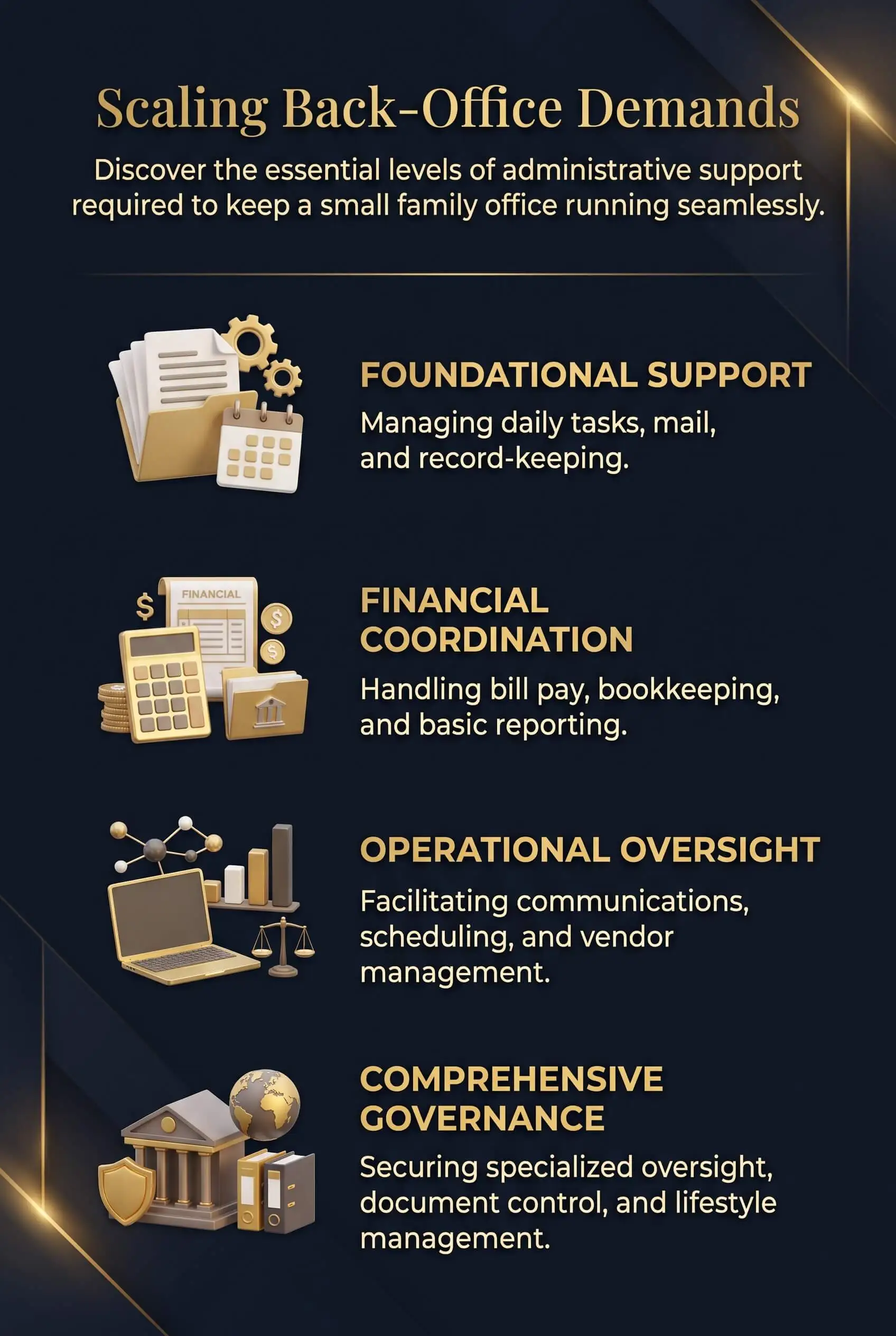
What it includes: Document management and electronic vaulting, bill pay, scheduling, provider coordination, entity records, signature and notary coordination, and insurance renewal tracking.
What it leaves to your advisors: Investment, tax, and legal advice. Your CPA, attorney, and insurance advisor keep their roles while the admin team keeps them connected.
How it works: Map your documents, providers, and obligations. Set up workflows and permissions. Track every action item to completion, then refine the system as life changes.
How much you need: Complexity sets the level. Most small family offices need one accountable coordinator, part-time or outsourced, rather than a full staff.
Who benefits most: Families with several entities, trusts, or properties, four or more advisors, or a sale, inheritance, or relocation ahead.
Top Takeaways
Most small family offices need structured, accountable support rather than a large staff.
Entities, properties, advisors, transitions, and generations drive the workload far more than net worth does.
Outsourced and hybrid models sidestep the hiring struggle and the risk of one employee holding everything.
Even a lean office needs separated payment duties, defined document permissions, and a written handoff file.
Administrative support coordinates your CPA, attorney, and insurance advisor and leaves their roles intact.
What Family Office Administrative Support Actually Covers
We think of administrative support as the engine of a family office. It keeps records current, puts every deadline on one calendar, and gives your advisors shared context to work from.
The traditional secretary or administrative assistant role began with correspondence and scheduling. Over the decades it took on records management, project work, and confidential information. The family office version adds one more job: holding the thread between your professionals.
For a small family office, the work usually includes:
Document management: We centralize wills, trusts, deeds, titles, tax returns, and insurance policies in a secure electronic vault with defined permissions and version control.
Bill pay and a cash calendar: Your coordinator pays property taxes, estimated taxes, insurance premiums, and household vendors on time and from the right account.
Scheduling across households: One calendar holds advisor meetings, signing appointments, travel, and family dates.
Provider coordination: A single liaison keeps your CPA, estate attorney, and insurance advisor aligned and tracks each action item until someone closes it.
Entity record continuity: The team maintains current records for every LLC, trust, and holding company, from annual filings to registered agent notices.
Signature and notary coordination: Your coordinator gets documents to the right signer and notary before the deadline.
Insurance schedule oversight: The team tracks renewals, coverage changes, and property schedules with every carrier.
Administrative support stops short of investment, tax, and legal advice. Your CPA, attorney, and insurance advisor keep those roles. We keep them connected and moving in one direction.
How Much Support Does a Small Family Office Need?
Complexity sets the workload. A family with $40 million in a single brokerage account and a paid-off home needs less help than a family with $15 million spread across an operating business, three LLCs, two trusts, and a beach rental.
We sort families into three tiers:
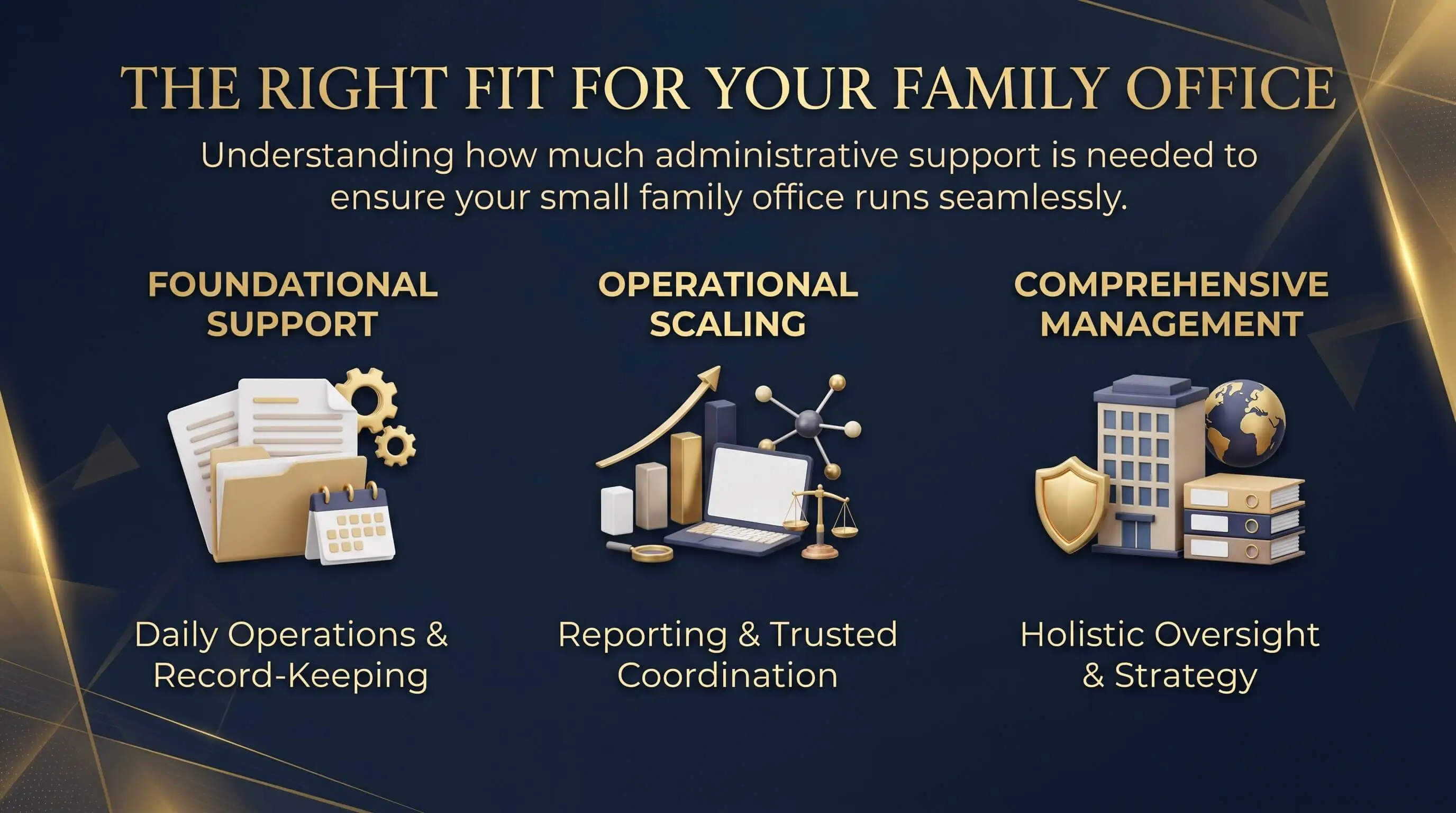
Streamlined: One household, one or two entities, and a stable group of advisors. A part-time or fractional coordinator and a secure document system usually cover it.
Growing: Several entities or properties, four or more advisors, and active estate or tax planning. These families typically need a dedicated outsourced team, or one in-house administrator with outside support behind them.
Complex: Multiple generations and households, an operating business, or a pending sale or inheritance. Here a family needs a full administrative function under an office lead, often through a multi-family office.
Most of the families we work with land in the first two tiers. A full staff would be more than they need. One team that owns a follow-through usually covers it.
Five Factors That Drive Your Administrative Workload
Score yourself on each one. Every factor that applies pushes you up a tier.
Entities and trusts. Each LLC, trust, and partnership brings its own filings, records, and signatures.
Properties and residences. A home comes with taxes, insurance, utilities, staff, and maintenance vendors.
Advisors to coordinate. Four professionals who never talk to each other create more work than one who handles everything.
Life transitions. A business sale, inheritance, relocation, or new estate plan can triple the admin load for a year or two.
Generations and households. Once you support parents, adult children, and grandchildren, the calendars, accounts, and documents multiply.
In-House, Outsourced, or Hybrid Administrative Support
Your tier tells you how much work exists. The next decision is who does it.
Cost structure: An in-house hire costs salary, benefits, payroll taxes, and equipment. An outsourced team usually charges a flat fee or retainer tied to scope. A hybrid pairs a smaller salary with a narrower outside scope.
Continuity: When an in-house employee leaves, their knowledge walks out with them. Outsourced teams share coverage and document their workflows. In a hybrid, the outside team holds the system and the in-house person keeps the daily rhythm.
Security: In-house, you build every safeguard yourself. An outsourced provider brings established systems and defined permissions. A hybrid follows the provider's standards.
Depth of expertise: One employee knows what one employee knows. An outsourced team gives you access to tax, estate, and records specialists. A hybrid keeps those specialists on call for complex work.
Scalability: In-house, new needs mean new hires. An outsourced scope expands or contracts with you. A hybrid flexes at both ends.
Families often underestimate how hard hiring is. In AlTi Tiedemann Global and Campden Wealth's 2025 research, 79% of family offices reported difficulty hiring staff. One wrong hire can cost a small office a full year.
That risk pushes many small families toward an outsourced or hybrid model. Legacy Bridge Private Family Offices provides administrative support inside a broader family office relationship, with one point of coordination and repeatable workflows that keep running when people change.
Controls Every Small Family Office Needs, Even With a Lean Team
Small offices often skip controls because only one or two people are involved. Lean staffing is precisely when you need defined permissions and secure handling standards.
Separate the money steps. Don't let one person set up a payment, approve it, and reconcile the account.
Define permissions. Decide who can view, edit, and share each category of document, then write it down.
Keep a handoff file. Store logins, advisor contacts, renewal dates, and recurring payments in a secure system rather than in one person's memory.
Know your retention rules. The IRS generally expects you to keep tax records until the period of limitations runs out, and property records longer.
Signs Your Current Admin Setup Is Stretched
Strain builds quietly. You may notice several of these at once:
You hunt for documents every tax season
Your advisors pass information through a family member instead of talking to each other
A renewal, filing, or payment slipped in the past year
The person handling everything is nearing retirement or burning out
Admin work regularly spills into evenings and weekends
Nobody outside the family could step in if something happened tomorrow
If three or more apply, your administration is running in reactive mode. The goal is a reliable system that sees deadlines coming.
Where School Calendars and Tuition Fit for Los Angeles Families
For many Los Angeles families, education ranks among the largest recurring expenses, and it generates its own paperwork. Enrollment contracts, deposits, financial forms, and private school tuition in Los Angeles all run on fixed deadlines, busy months or not.
A good administrative system puts those dates on the same calendar as property taxes and insurance renewals. It also tracks grandparent gifts and 529 contributions so they stay in step with the estate plan. When a family needs leadership beyond administration, such as a personal CFO or someone to direct the whole advisory team, that calls for outsourced family office executive services.
"Most families who come to us feeling overwhelmed already have good advisors. Nobody connects them. When we map a new family's documents, providers, and recurring obligations, we usually find the work getting done, but it lives in one person's inbox and memory. Hiring more people rarely fixes that. A secure, disciplined system does, because it keeps working when that person takes a vacation, retires, or simply runs out of evenings."
7 Essential Resources
BLS Occupational Outlook Handbook: Secretaries and Administrative Assistants. Current duties, pay, and outlook for administrative roles. Start here if you're pricing an in-house hire.
Umbrex: Staffing the Family Office. A practical guide that maps the work before choosing job titles and explains when fractional or outsourced help fits.
Umbrex: Typical Family Office Roles and Organization Structure. Sample structures for lean, mid-size, and institutional offices, plus the case for separating duties on even the smallest team.
IRS: How Long Should I Keep Records? The federal baseline for record retention. Use it when you set up a family document system.
AlTi Tiedemann Global and Campden Wealth: 2025 Family Office Operational Excellence Report. Survey findings from 146 single-family offices on talent, costs, outsourcing, and technology.
Deloitte Private: The Family Office Cybersecurity Report, 2024. How often attackers target family offices and which safeguards matter for your documents and payments.
Investor.gov: Check Out Your Investment Professional. The SEC's walkthrough for checking a firm's registration and history before you hire a provider that also acts as an investment adviser.
Supporting Statistics
79% of family offices report difficulty hiring staff. The AlTi Tiedemann Global and Campden Wealth 2025 Family Office Operational Excellence Report also found that C-level pay makes up 72% of total costs at small family offices, compared with 39% at large ones.
43% of family offices experienced a cyberattack in the prior 12 to 24 months. Deloitte Private's Family Office Cybersecurity Report, 2024 found North American offices the most likely targets, at 57%.
Executive administrative assistants earned a median of $76,590 a year. The U.S. Bureau of Labor Statistics reported that May 2025 figure, against $48,310 for secretaries and administrative assistants overall.
We see these numbers play out with the families we meet. Good people are hard to find. One salary eats a large share of a small office's budget, and attackers go straight for the documents and payments that staff handle. A structured outsourced system answers each of those pressures.
Final Thoughts
We judge it by one test. A family has the right amount of family office administrative support when no family member serves as the default coordinator anymore. For most small family offices, that means one accountable partner, a secure source of truth for records, and a disciplined system for follow-through.
We've watched families put this decision off because the current setup technically works. The bills get paid. The documents turn up eventually. The cost lands somewhere else: in lost evenings, a renewal that slips, and the scramble that follows when the one person holding everything together is unavailable.
Some families don't need outside help at all. With one household, a couple of accounts, and a CPA who handles the rest, a good document system and an annual review may cover it. Add family office concierge support when complexity grows faster than your family can track it. In our experience, that happens around a sale, an inheritance, or a new generation coming of age.
Frequently Asked Questions
What does family office administrative support include?
Family office administrative support typically covers document management in a secure vault, bill pay, scheduling, and coordination with your CPA, attorney, and insurance advisor. It also handles entity records, signatures and notarizations, and insurance renewals. The goal is to keep your financial life organized and moving. It does not include investment, tax, or legal advice.
How many staff does a family office need?
No fixed number applies. Many small family offices run well with one accountable coordinator, often part-time or outsourced, backed by outside specialists. Larger single-family offices with operating businesses and several generations may employ a full team. Map the work first, then decide who should do it.
Can a small family office run with one administrator?
Yes, as long as that person works inside a documented system with clear permissions and payment controls. The risk is concentration. If everything lives in one person's head, an illness, resignation, or retirement leaves the family scrambling. Pairing that administrator with outside support lowers the risk considerably.
Is it cheaper to hire an assistant or outsource family office administration?
That depends on scope. An in-house hire brings salary, benefits, payroll taxes, and equipment, and BLS reports that executive administrative assistants earned a median of $76,590 in May 2025. Outsourced providers usually charge a flat fee or retainer. Compare the total cost against the hours and expertise you actually need.
What is the difference between a family office administrator and an executive assistant?
An executive assistant usually manages one person's calendar, communications, and travel. A family office administrator manages the family's financial infrastructure, including records, entities, bills, insurance, and advisor follow-through. Some roles blend the two. The family office version centers on the household's financial system, not one person's schedule.
How do outsourced providers keep family documents secure?
Reputable providers use encrypted storage, multi-factor access, and permissions that spell out who can view or share each document. Ask any provider to walk you through its controls in plain terms. Ask, too, how it verifies payment requests, because email fraud ranks among the most common threats family offices face.
When should a family move beyond administrative support to a full outsourced family office?
Move up when the need shifts from organizing to leading. If you need someone to oversee cash flow across entities, coordinate a business sale, manage family foundation management responsibilities, or run family governance, you need executive-level help such as a personal CFO. Administrative support forms the foundation those services build on.
Ready for Less Admin, More Life?
Maybe your documents sit in five places, your advisors count on you to relay every update, or one person is quietly holding it all together. A more reliable system can take that weight off. The Legacy Bridge team starts by mapping your documents, providers, and recurring obligations. Then we put a practical structure in place through our family office services so your records stay organized, your providers stay aligned, and your administrative workload gets lighter. Schedule a private consultation to start the conversation.