Eight months after selling the business, a family in Brentwood has a CPA modeling next April's tax bill and an estate attorney redrafting two trusts. A wealth manager is investing the proceeds, an insurance agent is reviewing coverage on two homes, and tuition for three kids is due in August.
Multi family office services were built for exactly this moment. Each of those advisors is good at the job, but nobody owns the whole picture, so the family ends up coordinating itself, forwarding emails, chasing signatures, and trying to reconcile advice that never quite lines up.
A multi-family office is an independent firm that serves several wealthy families through one shared team, handling investments, tax and estate planning, trusts, reporting, and family governance inside a single relationship. Whether hiring one makes sense comes down to a trade most families never put numbers on. The fee shows up on a statement every quarter, while fragmented advice costs you in ways nobody itemizes, and in our experience that second number is usually the bigger one.
TL;DR Quick Answers
Multi Family Office Services
Multi family office services give a family one coordinated team for its full balance sheet, covering investments, tax and estate coordination, trust oversight, family governance, philanthropy, consolidated reporting, and administration. What you're really hiring is central accountability. One team keeps your CPA, attorney, and other advisors working from the same facts, so fewer decisions fall through the cracks.
How it differs from wealth management: A multi-family office starts with the whole balance sheet, while most wealth managers start with the investment account.
What it costs: About 0.5% to 1.5% of assets a year, a flat retainer, or a hybrid of the two.
When it pays off: Once complexity costs more than the fee, usually after a liquidity event or when several trusts and entities, disconnected advisors, or heirs nearing inheritance enter the picture.
What it won't do: Replace your CPA or estate attorney. It coordinates them.
How to vet a firm: Confirm fiduciary status, read the Form ADV and Form CRS, and get the all-in fee and scope in writing.
Top Takeaways
Whether a multi-family office is worth it depends more on how complex your wealth is than on your net worth alone.
Most multi-family offices charge about 0.5% to 1.5% of assets a year, a flat retainer, or a hybrid of the two.
Running a single-family office typically costs $1 million or more a year, so a multi-family office is cheaper for most families below several hundred million.
Most of the return comes from coordination, which means fewer dropped balls and one plan every advisor works from.
Before you sign, get the fees, the scope of services, and the firm's fiduciary status in writing.
What Multi Family Office Services Include, and What the Fee Covers
The fee buys coordination across your full balance sheet, and investment management is only one piece of that.
A typical scope covers investment oversight, tax and estate coordination, trust oversight, family governance, their education, philanthropy, consolidated reporting, and day-to-day administration. Plenty of advisors can list some of those. What a multi-family office adds is one team that owns how they fit together.
It helps to price the fee against what it replaces:
Outside help for reporting, bill pay, or entity bookkeeping
Duplicate fees when two advisors unknowingly cover the same ground
Hours of family time spent chasing documents and relaying messages between professionals
Planning windows that close because nobody owns the calendar, like estimated tax deadlines, trust funding, and annual gifting
Your CPA and estate attorney stay. The multi-family office keeps them working from the same facts on the same timeline, so their advice stops pulling in different directions.
How Much Does a Multi-Family Office Cost?
Expect to pay roughly 0.5% to 1.5% of assets a year, a flat annual retainer, or some mix of the two. Which structure fits depends on what your wealth looks like as much as on how much of it there is.
Asset-based: a percentage of assets under management, usually tiered lower as assets grow. It suits families whose investment portfolio is the largest piece of their wealth.
Flat retainer: a fixed annual fee for a defined scope of work. Families with significant wealth tied up in a business, real estate, or other illiquid assets often prefer it.
Hybrid: an asset fee for the portfolio plus a separate planning or family office fee, which fits families who need both investment management and broad coordination.
On $25 million, a 0.75% fee works out to $187,500 a year. On $50 million it's $375,000. Before you compare firms, ask what that number leaves out, since outside manager fees, custody, tax preparation, and trust administration are sometimes billed separately. Get the all-in annual cost in dollars, and get it in writing.
Fees usually step down as assets grow, and larger relationships have more room to negotiate scope.
The Break-Even Math: Multi-Family Office vs. Single-Family Office vs. Wealth Manager
Below several hundred million dollars, a multi-family office costs far less than running a private office and covers far more ground than traditional wealth management.
A single-family office is a business with a payroll. J.P. Morgan's 2026 Global Family Office Report found that offices managing $1 billion or more spend about $6.6 million a year to run. Smaller offices spend less in dollars, but fixed costs eat a much larger share of their assets. Put a $1.5 million budget against $50 million and you're paying 3% a year, while the same family would pay $375,000 at a 0.75% multi-family office fee.
Traditional wealth manager: usually an asset-based fee, often starting at $1 million to $10 million . The work centers on investments and financial planning, and the firm runs the relationship.
Multi-family office: about 0.5% to 1.5% of assets, a retainer, or a hybrid, with starting points anywhere from $10 million to $25 million or more depending on the firm . It covers the full balance sheet and coordinates your other advisors. You share the team with other families, but you set the scope and keep the decision rights.
Single-family office: $1 million or more a year, climbing with every hire, so few families consider one below $100 million . Everything is custom, and the family runs it as the employer.
When the main job is investment advice, a good wealth manager may be all a family needs. The gap opens once trusts, entities, business interests, and heirs enter the picture. If you're also weighing lighter outsourced options, our guide to outsourced family office executive services walks through how that model works.
When Does a Multi-Family Office Become Financially Worthwhile?
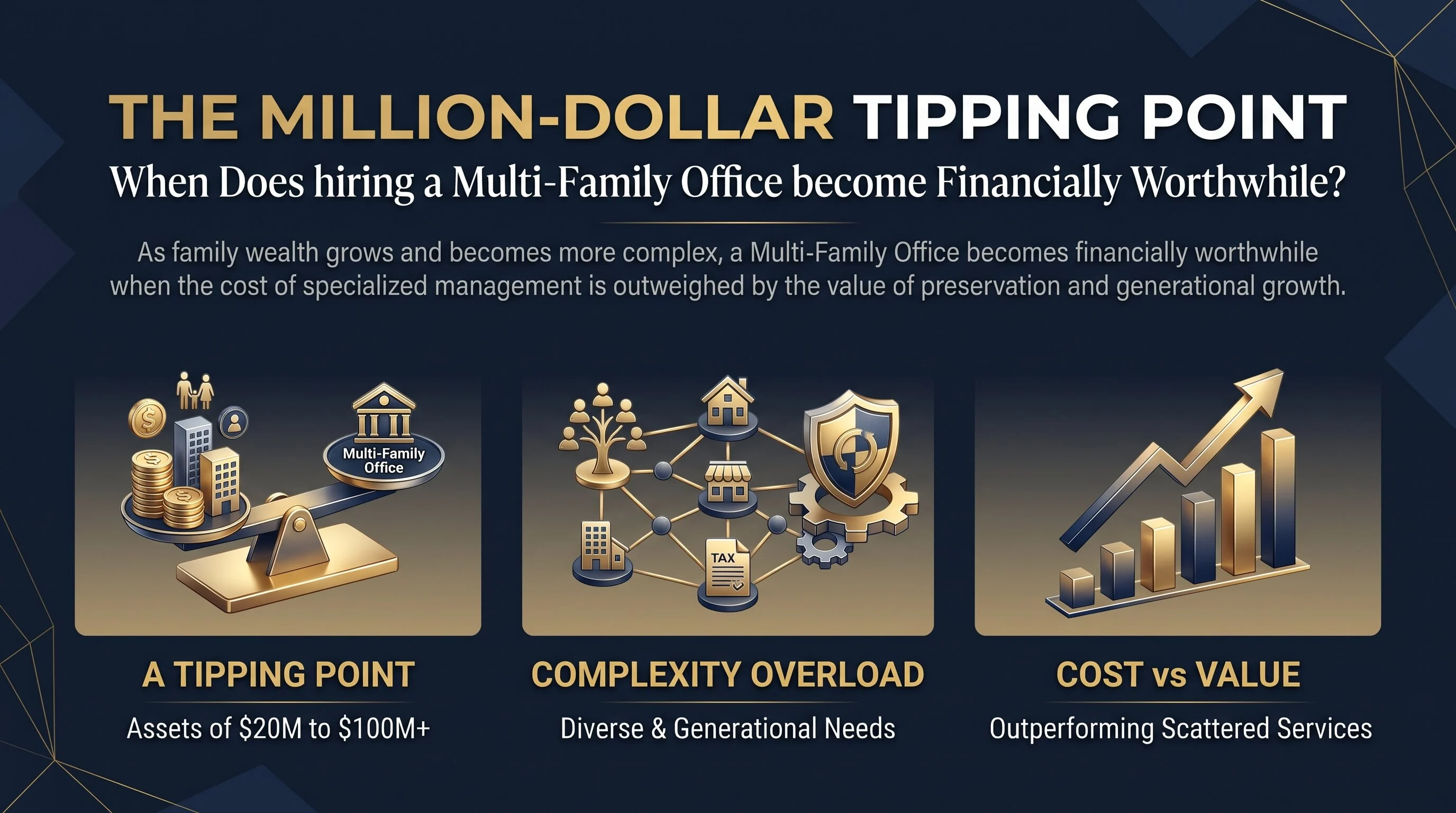
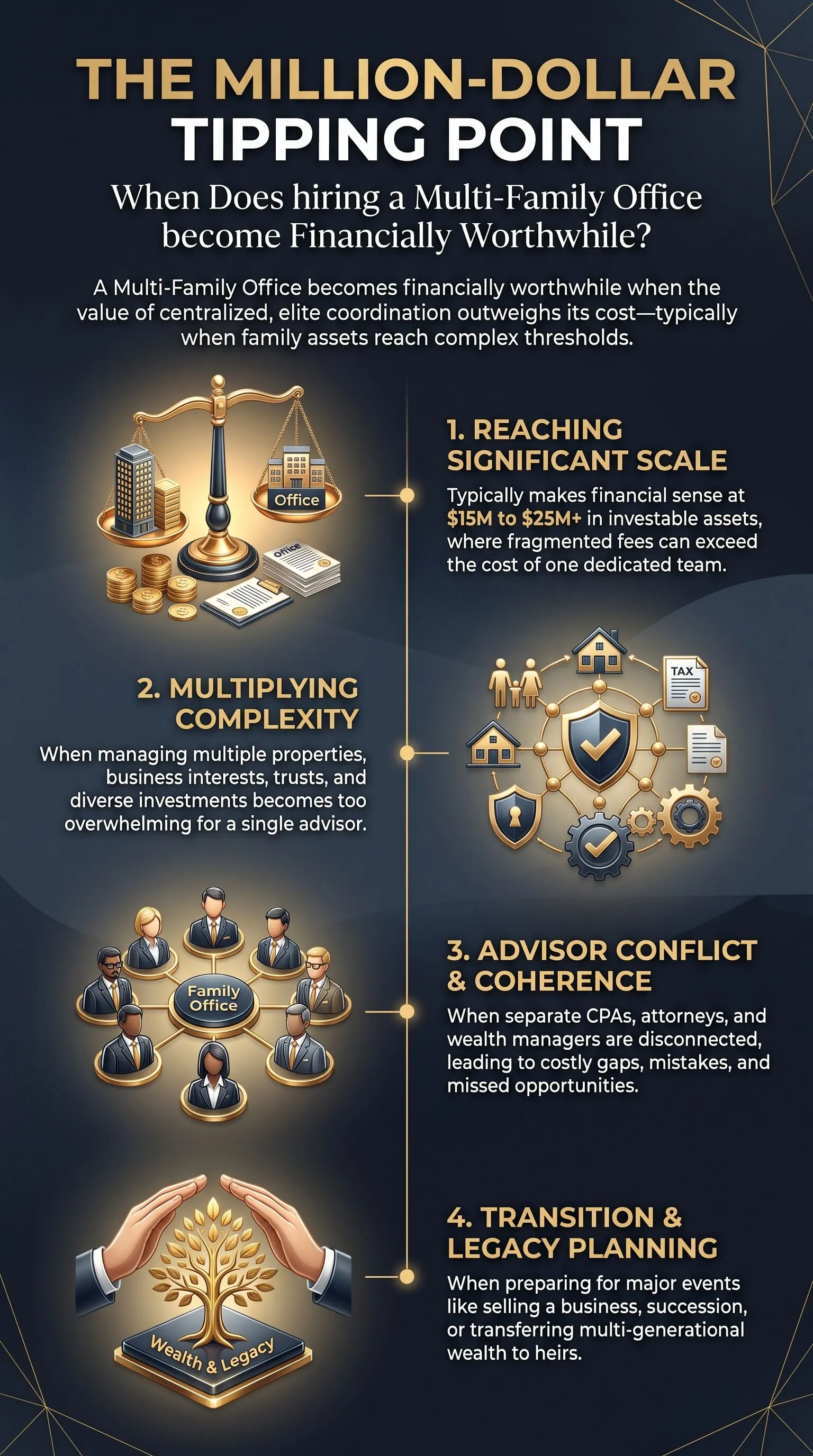
A multi-family office starts paying for itself once the complexity of your wealth costs more in mistakes, duplicated fees, and lost time than the fee does. For most families we talk with, that happens when two or three of these show up together:
A business sale, inheritance, or other liquidity event is coming up or just happened
You manage three or more trusts, LLCs, or partnerships
Your advisors rarely talk to each other, and you're the one relaying information
A large share of your wealth sits in one stock, one business, or one real estate portfolio
Children or grandchildren are getting close to inheriting or managing assets
You run a private foundation or donor-advised fund
Your family has homes, entities, or tax obligations in more than one state
As a rough rule, a single trigger at $5 million rarely justifies the fee. At $10 million or more, two or three triggers are worth a serious conversation, and past $25 million with a business interest in the mix, coordination usually covers its own cost.
The savings don't have to be dramatic. One unfunded trust, an outdated beneficiary designation, or a sale timed without the tax picture in view can cost more than several years of fees.
The Value That Never Shows Up on a Fee Statement
What families notice first is better decisions, because one balance sheet, one timeline, and one accountable person replace the back-and-forth between advisors.
Day to day, it looks quieter than people expect. Recommendations stop contradicting each other, and reports arrive on schedule in a format someone actually reads.
Picture a family with most of its net worth in one company's stock. The CPA wants to delay a sale for tax reasons, the wealth manager wants to diversify, and the attorney is building a gifting plan around the same shares. Each recommendation holds up on its own. A multi-family office puts all three in one conversation, models the tradeoffs, and hands the family a single plan it can follow.
Heirs gain something too. Children who understand how the family's wealth is structured come to the table far better prepared than children who learn it all at once.
When a Multi-Family Office Isn't Worth It, Yet
We'll say this plainly. Some families don't need one.
Most of your wealth sits in retirement and brokerage accounts
You work with one or two advisors who already do good work
Investment management is the only service you want
If that sounds like you, a strong fiduciary wealth manager is probably the better fit for now. Revisit the question after a sale, an inheritance, or a new trust, because that's usually when complexity jumps.
Where Tuition and Education Planning Fit for Los Angeles Families
Education is one of the largest recurring checks many Los Angeles families write. Tuition for two or three children, help from grandparents, 529 plans, and education trusts all have to fit with cash flow and the estate plan.
A multi-family office treats tuition as a line in the full plan rather than a stand-alone bill. The team schedules payments around liquidity, times grandparent gifts to fit the gifting strategy, and reviews college savings every year. If you're still working out the numbers, start with our breakdown of private school costs in Los Angeles and our guide to affording private schools in California.
How to Tell if a Firm Will Earn Its Fee
Bring these questions to every first meeting:
Is the firm a fiduciary and a registered investment adviser? You can check its record on the SEC's Investment Adviser Public Disclosure site.
What do its Form ADV and Form CRS say about fees and conflicts of interest?
What is the all-in annual cost, in dollars?
Which services are in scope, and who owns each one?
How will the team work with your current CPA, attorney, and trustee?
Can you see a sample consolidated report?
Who tracks open planning items between meetings?
Clear fees and a written scope aren't extras. A firm that hesitates on any of these questions is telling you something.
“In our experience, the first 90 days show whether the fee will earn its keep. A strong firm gathers every statement, trust agreement, and entity document, builds one consolidated balance sheet, and hands back a ranked list of open items. Families are often surprised by what turns up: a trust that was signed and never funded, a beneficiary form nobody updated after a divorce, or cash sitting idle while a tax bill comes due. Each one looks small, and catching it early can be worth more than a year of fees.”
7 Essential Resources
J.P. Morgan Private Bank: 2026 Global Family Office Report. Survey data from 333 family offices, including what it costs to staff and run one at different asset levels.
Morgan Lewis: Control, Cost, and Complexity. A law firm's side-by-side look at single-family, multi-family, and hybrid office models.
Citi Private Bank: The Costs of Operating a Family Office. A breakdown of internal operating costs, with a useful case for judging cost against the value delivered.
BNY Wealth: Key Considerations When Creating a Family Office. Shows how the same budget translates into very different basis-point costs at different asset levels.
RBC Wealth Management: Considering a Family Office?. Explains how shared overhead lets a multi-family office offer a broader range of expertise.
SEC Investment Adviser Public Disclosure. Look up any advisory firm's registration, Form ADV, and disciplinary history before you hire it.
IRS: Donor-Advised Funds. The IRS overview of one of the most common giving vehicles a multi-family office helps coordinate.
Supporting Statistics
$6.6 million a year. That's the average annual operating cost for family offices managing $1 billion or more, up from $6.1 million in J.P. Morgan's previous survey. Source: J.P. Morgan Private Bank 2026 Global Family Office Report, as reported by Citywire.
About 260 basis points. BNY Wealth shows that an office running on roughly $6.5 million a year costs about 2.6% of assets when it manages $250 million. The same budget is a much smaller share at $1 billion.
0.5% to 1.5% of assets. This is the typical annual fee range for a multi-family office, compared with $1 million or more a year to run a single-family office. Source: Asora.
Set side by side, these figures explain why break-even comes earlier than most families expect. A staffed private office costs a great deal at any size, while a multi-family office fee moves with your assets.
Final Thoughts
Most families weighing a multi-family office start by asking what it will cost, when the more useful question is what fragmentation is already costing them.
Our view is that the fee earns its place once your wealth has more moving parts than any single advisor can see. Usually that means a business interest, a handful of trusts or entities, a liquidity event, or a generation getting ready to step in. At that stage you pay for coordination either way, whether to a firm or through missed deadlines, conflicting advice, and evenings spent doing the job yourself.
The other side deserves the same candor. If your finances are simple and your advisor is doing good work, you don't need multi-family office services yet, and nobody should push you into them.
If two or three of the triggers above already describe your family, now is a sensible time to start that conversation.
Frequently Asked Questions
How much do multi family office services cost?
Most firms charge between 0.5% and 1.5% of assets each year, a flat annual retainer, or a hybrid. On $25 million, a 0.75% fee comes to $187,500 a year. Ask every firm for its all-in annual cost in dollars, including outside managers, custody, and tax preparation.
What net worth do you need to hire a multi-family office?
No single number applies. Many firms start around $25 million, and some work with families from $10 million. Complexity matters more than the total. A family with $12 million, a business interest, and three trusts may need a multi-family office more than a family with $30 million held in index funds.
Is a multi-family office cheaper than a single-family office?
For most families, yes. A staffed single-family office usually costs $1 million or more a year, and J.P. Morgan found offices with $1 billion or more average about $6.6 million. A multi-family office spreads that infrastructure across many families, so each one pays a fraction of the cost.
Is a multi-family office worth it if I already have a financial advisor?
It can be, depending on how much of your financial life your advisor actually coordinates. Most advisors focus on investments and planning. A multi-family office takes on the full balance sheet, including trusts, entities, tax coordination, governance, and reporting, and keeps your other advisors aligned.
Does a multi-family office replace my CPA or estate attorney?
No. Your CPA and attorney continue to give tax and legal advice. The multi-family office makes sure they have what they need, stay in sync with each other, and follow through on what the family decides.
What are the signs it's time to hire a multi-family office?
The common signs are a business sale or inheritance, three or more trusts or entities, advisors who don't communicate, a concentrated position, heirs nearing inheritance, or a foundation to manage. Two or three of these together usually justify a conversation.
Can a multi-family office help plan for private school and college costs?
Yes. A multi-family office can schedule tuition around cash flow, time grandparent gifts and 529 contributions with the estate plan, and review education savings each year. It can also help prepare the next generation to understand the family's wealth.
Find Out if Your Family Has Outgrown Its Advisors
Coordinating trusts, entities, a business interest, and a handful of advisors shouldn't be a job you do on nights and weekends. The Legacy Bridge team begins its family office services by mapping your full balance sheet: who's involved, how everything connects, and where things tend to slip. From there, you'll see clearly what one coordinated team would cost and what it would take off your plate. Schedule a private consultation to start that conversation.