Tuition clears through one portal, summer camp deposits through another, and the Saturday gym rental shows up as a paper check. For plenty of private schools in Los Angeles, that's an ordinary Monday. Can outsourced bookkeeping keep it all straight? Yes, as long as each income source gets its own lane in the books and someone reconciles every platform each month.
We've provided outsourced bookkeeping services since 2015, for schools, studios, service firms and nonprofits, and one pattern shows up again and again. Revenue grows in several directions at once while the books stay built for one.
Add uniform sales and a spring gala to that school, and it all lands in the same bank account. Leadership knows the school is busy. What they usually can't tell you is which program makes money and which one drains it.
TL;DR Quick Answers
outsourced bookkeeping services
Outsourced bookkeeping services give you a team that records, reconciles and reports your finances each month without the cost of an in-house hire. For a business with multiple revenue streams, the real value is seeing what each stream earns on its own.
What you get: transaction recording, bank and payment-platform reconciliations, a fixed monthly close, and financial statements you can act on.
Multi-stream setup: a chart of accounts built around each income source, plus class or location tracking in QuickBooks Online or Xero for a profit and loss report per stream.
Why it helps: you can see which programs make money, which ones only look busy, and when cash will run tight.
Cost: pricing follows transaction volume and complexity rather than headcount. Accountix bookkeeping starts at $200 per week.
Best fit: schools, nonprofits, creative studios, service firms and growing businesses that have outgrown DIY books but don't need a full finance department yet.
Next level: add outsourced accounting for budgets and forecasts, or a fractional CFO for growth strategy, as the business moves from stressed and reactive to structured and strategic.
Top Takeaways
Outsourced bookkeeping works for multi-stream businesses when each stream is tracked on its own and reconciled monthly.
A chart of accounts built around your income sources, plus class or location tracking, makes per-stream profit visible.
Shared costs need one consistent allocation rule, or a single program will look profitable at another's expense.
In California, mixed taxable and nontaxable sales need clean separation before every sales tax return.
An outsourced team brings tested multi-stream setups for less than the cost of building an in-house finance department.
Can Outsourced Bookkeeping Help a Business With Multiple Revenue Streams?
With one product and one way to get paid, bookkeeping stays fairly simple. Add a second or third income source and the job changes shape, because someone now has to sort, match and assign every dollar to the part of the business that earned it.
Why Multiple Revenue Streams Complicate the Books
Every new stream adds another place for the numbers to drift. When we take over a set of multi-stream books, the trouble usually traces back to a handful of causes:
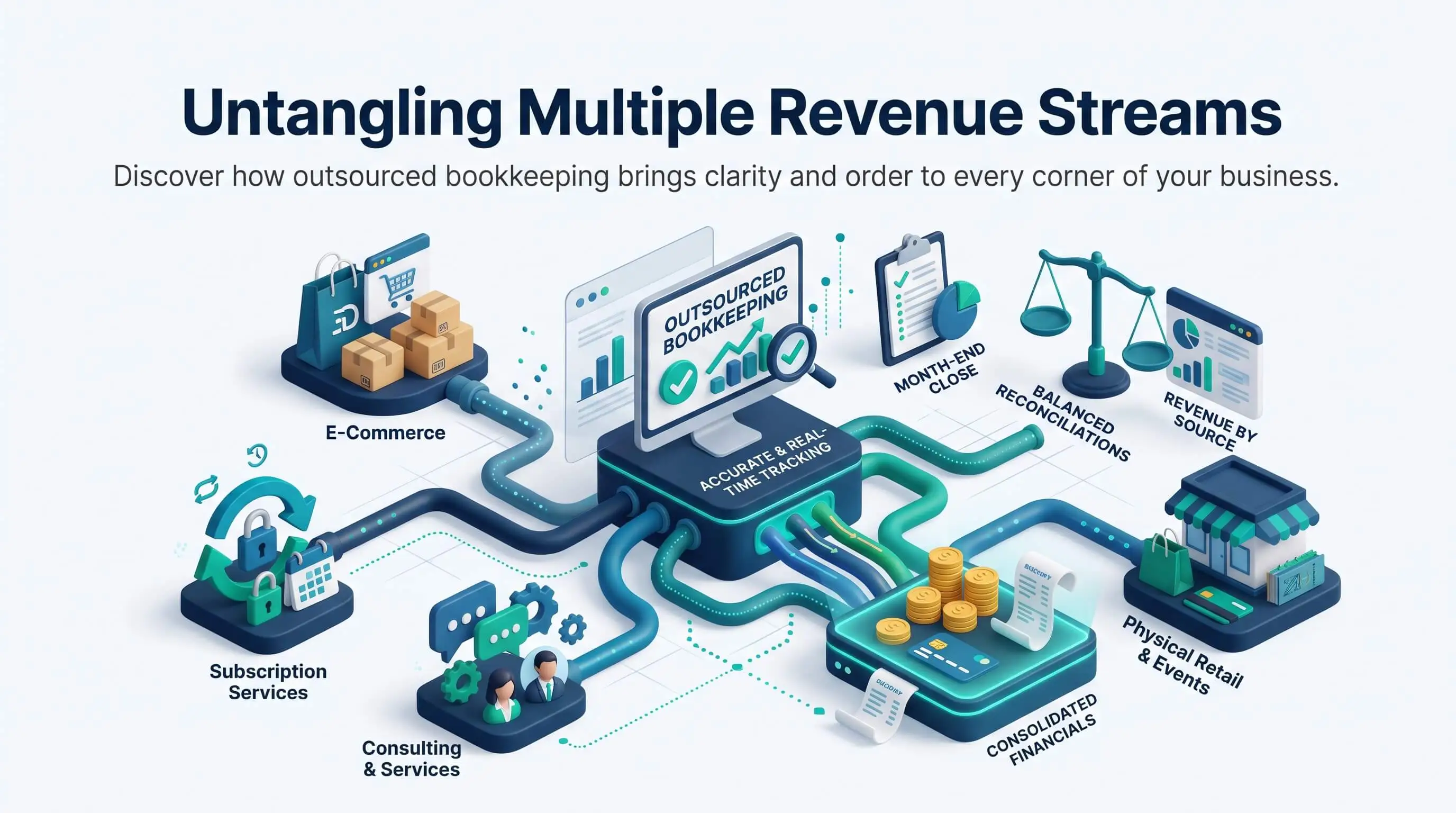
Mixed deposits. Three programs pay into one checking account, so a single deposit can hold three kinds of income.
Platforms that don't agree. Tuition software, Stripe, Square and a donation tool each pay out on their own schedule and quietly subtract their own fees.
Different tax treatment. In California, a uniform sale usually carries sales tax while a class fee doesn't, and blending them invites errors on the return.
Shared costs with no rule. Rent, utilities and staff hours support every program, so without an allocation method one stream looks healthy at another's expense.
Uneven timing. Camp fees arrive in spring, tuition in late summer, gifts in December. Cash looks fine right up until it doesn't.
How Outsourced Bookkeeping Services Keep Each Stream Separate
The fix is structure rather than extra hours. Here's what we build for most multi-stream clients:
A chart of accounts organized around your streams. Each income source gets its own revenue account, so tuition never blends with rentals.
Class or location tracking. We tag every transaction to a program in QuickBooks Online or Xero, which lets you pull a profit and loss report for each one.
Platform-by-platform reconciliation. We match each processor payout to the sales behind it and record the fees separately instead of letting them disappear into a net deposit.
A written cost allocation rule. You choose the basis, such as square footage, staff hours or revenue share, and we apply it the same way every month.
A month-end close on a fixed date. You get reports you can act on rather than a list of transactions.
What you end up with is one consolidated set of books that still reads stream by stream.
A Private School Example: Five Revenue Streams, One Clear Picture
Take an illustrative independent school with five income sources: tuition, summer camp, after-school care, weekend facility rentals and an annual giving fund. Families weighing how to afford private school in California see a single bill, but the business office is effectively running five small businesses.
Without a stream-based setup, the office can report total revenue and total expenses and not much else. With one, the monthly report starts answering sharper questions:
Tuition covers core teaching staff, but only after we record financial aid as a tuition discount rather than an expense.
Summer camp brings in strong revenue, yet extra counselors and insurance shrink its margin to almost nothing.
Weekend rentals add modest income at nearly zero added cost, which makes them the most profitable dollar on campus.
Restricted gifts sit apart from operating cash, so the school spends them only the way donors intended.
None of that takes new software, only books organized around how the school actually earns money. Schools run as nonprofits also face rules on restricted gifts, which this nonprofit bookkeeping checklist for volunteer treasurers covers in more depth.
Outsourced vs. In-House vs. DIY for Multi-Stream Businesses
Each option can work, though they hold up very differently once a second or third stream arrives.
DIY (owner or office staff)
Costs little in cash and a lot in evenings and weekends
Usually falls behind during the busiest months, which is when you need the numbers most
Tends to produce reports only at tax time
In-house bookkeeper
Adds salary, benefits and software to your payroll
Leaves gaps during vacations, leave or turnover
Depends on one person's experience with multi-stream setups
Makes sense once your transaction volume justifies a full finance department
Outsourced bookkeeping
Runs on a scoped fee that often comes in below the cost of one hire
Gives you team coverage all year, so the close doesn't stall when someone's out
Brings setups we've already tested across 150+ clients
Lets you add outsourced accounting or fractional CFO support as you grow
Delivers a monthly close with stream-level reports
For the long stretch before a full internal team makes sense, outsourcing usually buys more expertise per dollar.
Signs Your Business Has Outgrown DIY Bookkeeping
Most owners wait for a tax-season scramble before asking for help. You don't have to. These are the signals we watch for:
Your books close weeks late, or only once a year.
Payouts in Stripe or Square don't match what hit the bank.
Nobody can say which revenue stream is the most profitable.
Sales tax on mixed taxable and nontaxable sales feels like guesswork.
One person holds every financial process in their head.
You're reconciling accounts at 10 p.m. instead of running the business.
If two or more of those sound familiar, staying DIY is probably costing more than it looks.
"We've worked with more than 150 clients since 2015, and owners with several revenue streams rarely lack income, though most lack a clear view of it. The pattern repeats often enough that we expect it now. The program everyone assumes carries the business turns out to break even once staff time is allocated, while a side line nobody watches is quietly covering the rent. Seeing that on a report, usually within the first couple of monthly closes, changes what an owner decides next. That's the point we work toward with every client."
7 Essential Resources
1. IRS Publication 583: Build the Record System Every Stream Depends On
This IRS publication lists the records a business has to keep and walks through a sample recordkeeping system. We send new clients here first, since separating revenue streams only works when the records underneath are complete from day one.
Source: https://www.irs.gov/publications/p583
2. Taxpayer Advocate Service: Match Your Records to Your Filings
The IRS Taxpayer Advocate Service breaks down which federal forms apply to each business type and what a workable recordkeeping system should track. It's a handy cross-check when one owner runs income through more than one entity or schedule.
3. U.S. Small Business Administration: Understand Accounting Methods and Segment Analysis
The SBA's guide covers balance sheets, cash versus accrual accounting, and when to bring in a bookkeeper or CPA. It also suggests analyzing business segments separately, such as online sales against in-person sales, which is the same idea behind stream-level reporting.
Source: https://www.sba.gov/counseling/manage-your-business/
4. QuickBooks Online Class Tracking: See the Setting Behind Per-Stream Reports
Intuit's help article shows how to turn on class tracking and tag transactions to departments or product lines. In many of our setups, this one setting is what turns a single ledger into a separate report for each program.
Source: https://quickbooks.intuit.com/learn-support/en-us/regular-payroll/set-up-class-tracking/00/369849
5. CDTFA Tax Guide for Nonprofit Organizations: Know Which School and Program Sales Are Taxable
California's tax agency points out that nonprofits don't get a broad sales tax exemption, and it spells out which activities count as sales. Schools and enrichment programs that sell merchandise alongside services can use it to keep taxable and nontaxable revenue apart.
Source: https://cdtfa.ca.gov/industry/nonprofit-organizations/industry-topics.htm
6. CDTFA Sales and Use Tax Filing Instructions: Report Mixed Sales Correctly
These instructions show how California sellers report total sales and then deduct the nontaxable portion. When several streams feed one return, clean stream-level books make that deduction faster to calculate and much easier to defend.
Source: https://cdtfa.ca.gov/CROS/online-filing-instructions.htm
7. SCORE 12-Month Profit and Loss Projection: Plan Each Stream's Year Ahead
SCORE's free template asks owners to think through where income comes from and how it shifts across the year. We like it as a simple first forecast for each revenue stream, and it gives your bookkeeper something concrete to measure against.
Source: https://www.score.org/resource/12-month-profit-and-loss-projection
3 Statistics
1. 94% of the smallest employer firms faced at least one financial challenge in 2025.
In the Federal Reserve's Small Business Credit Survey, 94% of employer firms with one to four employees reported at least one financial challenge, and uneven cash flow is one of the challenges the survey tracks. Multi-stream businesses feel this hardest in our experience, because each source pays out on its own calendar.
Source: https://fred.stlouisfed.org/series/SBCSS10B2V1FRB
2. More than 30.4 million U.S. nonemployer businesses brought in nearly $1.8 trillion in 2023.
The Census Bureau counted 30,427,808 nonemployer establishments in 2023, up from roughly 29.8 million a year earlier. Plenty of them are side ventures or second income lines run next to a main business, and that's exactly where blended books start causing trouble.
Source: https://www.census.gov/library/stories/2026/05/small-business-week.html
3. Small business income with little third-party reporting had a 55% net misreporting rate, compared with 1% for wages.
The Committee for a Responsible Federal Budget's review of IRS tax gap data found that, for 2014 to 2016, income with little outside reporting, like small business and rental income, was misreported far more often than wages. The risk climbs as streams multiply, which is why we reconcile every platform to the books each month.
Source: https://www.crfb.org/blogs/irs-estimates-625-billion-tax-gap
Final Thoughts and Opinion
We think multiple revenue streams are a genuine strength, but only once you can measure each one. Diversified income protects a business from a slow season or a lost client. Without stream-level books, that same mix hides which programs carry the business and which ones cost it.
Our approach rests on what we call People. Process. Technology. Experienced bookkeepers set up a chart of accounts around your streams, a fixed monthly close keeps it current, and cloud tools like QuickBooks Online tie every platform together. Once that's in place, the decisions get easier, whether you're pricing next summer's camp or finally dropping a service that never paid for itself.
That's where outsourced bookkeeping services earn their keep. You get a team that has set up multi-stream books many times before, without hiring a finance department ahead of need. For a private school, a tutoring center, a creative studio or a firm with several service lines, it's how growth stops being a guess.
Frequently Asked Questions
How does outsourced bookkeeping track multiple revenue streams?
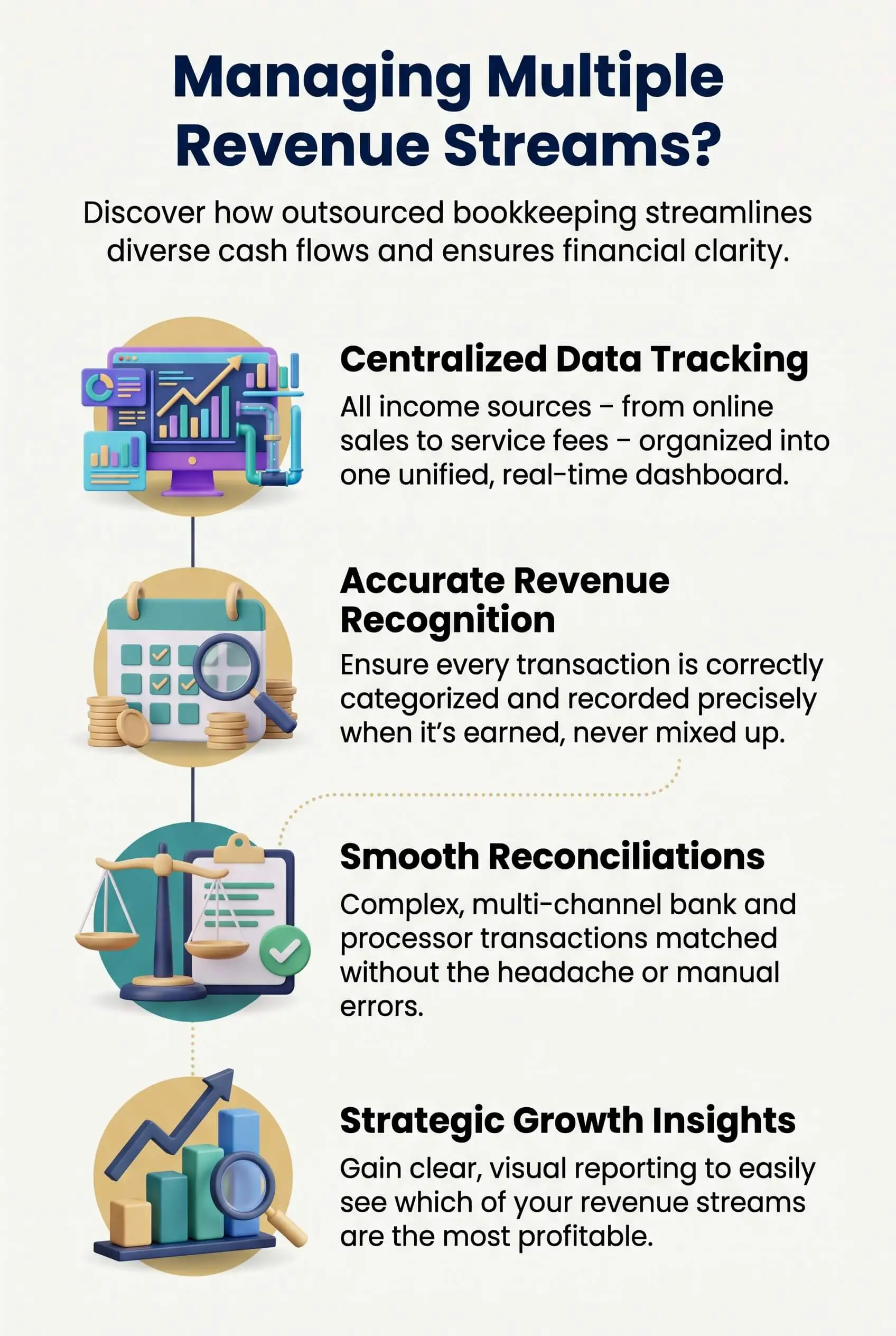
We set up a separate revenue account for each income source and tag every transaction to its program with class or location tracking. Each payment platform gets reconciled to the books monthly, so you can run a profit and loss report for any single stream as easily as for the whole business.
Can one bookkeeper handle bookkeeping for multiple businesses or LLCs?
Yes. Plenty of owners run related ventures as separate entities. An outsourced team keeps a distinct set of books for each one, records transfers between them correctly, and can roll everything into a consolidated report without mixing finances that should stay legally separate.
How much do outsourced bookkeeping services cost for a multi-stream business?
Pricing depends on transaction volume, the number of accounts and platforms, and how much reporting you want, not on headcount. Accountix bookkeeping starts at $200 per week, and we scope each engagement after an intro call. Expect a multi-stream business to cost somewhat more than a single-stream one, simply because there's more to reconcile.
Is outsourced bookkeeping secure when several payment platforms are connected?
It can be very secure when the provider handles access carefully. Look for cloud-based accounting software, role-based permissions and multi-factor authentication, with each person seeing only what their work requires. Ask any provider how they manage permissions and what happens to their access if you part ways.
When should a business move from bookkeeping to outsourced accounting or a fractional CFO?
Bookkeeping records and reconciles what already happened. Move up when you need budgets against actuals, cash flow forecasts or advice on which stream to grow. Outsourced accounting adds a full monthly close and analysis, and a fractional CFO adds forward-looking strategy, which often fits once several streams compete for the same staff and cash.
Get Clear on Every Revenue Stream
your business earns money in more than one way, your books should show how each stream is performing. As an outsourced accounting firm, Accountix Solutions works with schools, nonprofits, service firms and growing businesses across California and the U.S. to move them from stressed and reactive to structured and strategic.
Book a 30-minute intro call with our team. It's a no-obligation conversation with no sales pitch, just clarity on where your books stand and what level of support fits right now.