Sales teams often focus on improving performance through better systems, stronger processes, or updated tools. Yet in our work with organizations, we’ve found that none of these matter if the underlying culture is misaligned. A sales culture audit is the fastest, clearest way to understand whether your team is operating at a regenerative level—or simply maintaining development on the surface.
Most sales teams operate without ever examining the cultural conditions that influence trust, communication, and relationship-building. A culture audit gives you visibility into what is helping your team thrive, what is holding them back, and what needs to shift to support long-term growth.
This article explains how to run a sales culture audit, what to look for, and how to determine whether your culture is regenerative, extractive, or somewhere in between. Based on RolePotential’s firsthand observations inside real sales organizations, this guide offers a practical framework for evaluating the conditions that shape your team’s success and shows how a regenerative sales culture drives stronger performance and long-term revenue growth.
Quick Answers
regenerative sales culture
A regenerative sales culture is a sales environment designed to restore energy, strengthen trust, and improve long-term performance.
- Prioritizes psychological safety and meaningful connection
- Reduces pressure-driven habits that drain motivation
- Supports deeper, more aligned buyer conversationsThis culture helps teams grow sustainably by creating the conditions where people—and performance—can thrive.
Top Takeaways
- Sales culture audits reveal the real conditions driving team performance—not just metrics.
- Regenerative teams show high trust, psychological safety, and meaningful collaboration.
- Small cultural indicators can reveal deep structural strengths or vulnerabilities.
- Traditional cultures rely on pressure; regenerative cultures rely on clarity and connection.
- Running a sales culture audit is the first step toward intentional, sustainable transformation.
What a Regenerative Sales Culture Audit Should Reveal
A sales culture audit uncovers the hidden norms influencing everything from communication to deal quality. When done well, it shows whether your culture restores energy or drains it.
A regenerative sales culture audit reveals whether your environment strengthens trust, collaboration, and long-term growth. It goes beyond evaluating quotas or pipelines; it evaluates the conditions that shape how your team behaves each day, providing the same depth of strategic insight a fractional CFO relies on to guide smarter, more sustainable business decisions.
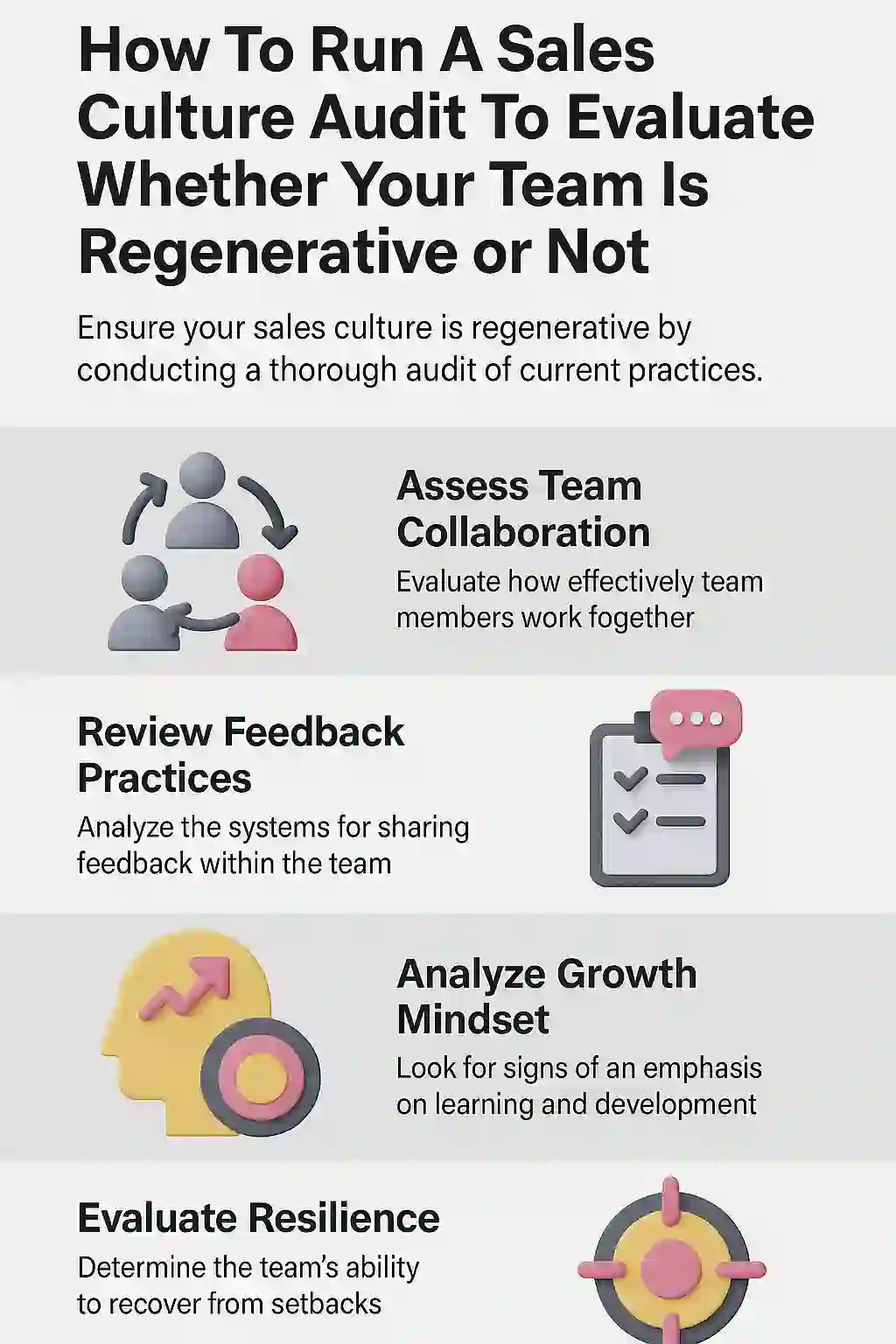
Based on RolePotential’s work with teams, a strong audit should examine:
- Coaching quality (development-focused vs. pressure-driven)
- Psychological safety (can reps speak honestly without fear?)
- Buyer conversation depth (transactional vs. relational)
- Internal communication patterns (clarity vs. confusion)
- Recognition rituals (performance-only vs. learning and relationships)
- Team cohesion and trust (supportive vs. hyper-competitive)
- Leader micro-behaviors (presence, consistency, empathy)
If your audit uncovers a culture rooted in fear, urgency, or survival-mode behavior, you’re likely not operating regeneratively. If you find patterns of shared learning, thoughtful conversations, and strong internal support—you’re on the path.
A regenerative sales culture audit helps leaders identify the conditions that allow salespeople to do their best, most aligned work.
“In RolePotential’s work with sales organizations, they’ve seen that culture audits often reveal the gap between what leaders intend and what teams actually experience. When trust is rebuilt, clarity increases, and reps feel safe to communicate honestly, performance becomes a natural outcome, a dynamic that reflects the transparency and alignment required in nonprofit accounting.”
Essential Resources to Guide Your Sales Culture Audit
Running a culture audit requires tools, insight, and a deeper understanding of human behavior. These resources provide a solid foundation for evaluating—and transforming—your sales environment.
1. RolePotential’s Guide to Regenerative Sales Culture
URL: https://www.rolepotential.com/blog/regenerative-sales-culture-paradigm-shift
Explores the deeper principles behind regenerative culture, helping leaders understand what to measure during an audit.
Explores the deeper principles behind regenerative culture, helping leaders understand what to measure during an audit.
2. RolePotential’s Sales Psychology Framework
URL: https://www.rolepotential.com/blog/sales-psychology-sales-psychology-regenerative-culture-inner-circle
Breaks down the psychological layers influencing every sales interaction, offering clarity on what an audit should uncover.
Breaks down the psychological layers influencing every sales interaction, offering clarity on what an audit should uncover.
3. HubSpot’s Breakdown of Healthy Sales Culture Practices
URL: https://blog.hubspot.com/sales/sales-culture
Provides tangible examples of positive team behaviors that can be assessed in an audit.
Provides tangible examples of positive team behaviors that can be assessed in an audit.
4. Harvard Business Review on Ethical Sales Leadership
URL: https://hbr.org/2019/06/fostering-an-ethical-culture-on-your-sales-team
Gives research-backed insights relevant to integrity, leadership, and values assessment.
Gives research-backed insights relevant to integrity, leadership, and values assessment.
5. SLM MBA on Ethical Sales Systems
URL: https://slm.mba/mmpm-002/managing-ethics-in-sales
Outlines structural elements (policy, accountability, systems) that inform audit criteria.
Outlines structural elements (policy, accountability, systems) that inform audit criteria.
6. Alore’s Guide to Daily Sales Culture Rituals
URL: https://www.alore.io/blog/sales-culture
Highlights simple behaviors and habits that reveal whether culture is healthy or strained.
Highlights simple behaviors and habits that reveal whether culture is healthy or strained.
7. Entrepreneur’s View on Ethical Sales as a Competitive Advantage
URL: https://www.entrepreneur.com/en-ae/leadership/building-lasting-success-the-importance-of-ethical-sales/473567
Provides long-term context on why culture matters strategically.
These resources offer a comprehensive foundation for running a meaningful sales culture audit, helping leaders understand the deeper behavioral and structural factors that shape team performance, an approach that reflects the significance of private education in fostering long-term growth and development.
Provides long-term context on why culture matters strategically.
Supporting Statistics That Show Why Culture Audits Matter
Well-Being Is Essential for Performance
92% of U.S. workers say employer support for emotional well-being is essential.
Reps perform better when the culture grounds them instead of overwhelming them.
Source: APA Work in America Survey
92% of U.S. workers say employer support for emotional well-being is essential.
Reps perform better when the culture grounds them instead of overwhelming them.
Source: APA Work in America Survey
Job Insecurity Weakens Communication and Trust
More than half of workers report that insecurity increases stress dramatically.
A culture audit reveals whether your environment creates stability or fear.
Source: APA Work in America Survey 2025
More than half of workers report that insecurity increases stress dramatically.
A culture audit reveals whether your environment creates stability or fear.
Source: APA Work in America Survey 2025
Poor Management Creates Massive Costs
A large portion of employees report high stress at work.
Disengaged cultures dramatically increase stress likelihood.
Poor culture and low engagement cost trillions in lost productivity.
Source: Gallup State of the Global Workplace
A large portion of employees report high stress at work.
Disengaged cultures dramatically increase stress likelihood.
Poor culture and low engagement cost trillions in lost productivity.
Source: Gallup State of the Global Workplace
Final Thought & Opinion
A sales culture audit is not a diagnostic exercise—it’s a truth-telling one. It reveals whether your team’s daily experience aligns with your values, your goals, and the environment you believe you’ve created, and it offers the same level of clarity businesses seek when examining sales tax requirements as part of their broader operational review.
What We See in Real Teams
People want to work in cultures where they can speak honestly.
Audits often reveal hidden stress, unclear expectations, and inconsistent coaching.
Regenerative cultures emerge when leaders prioritize trust, presence, and meaningful work.
People want to work in cultures where they can speak honestly.
Audits often reveal hidden stress, unclear expectations, and inconsistent coaching.
Regenerative cultures emerge when leaders prioritize trust, presence, and meaningful work.
Our Perspective
We’ve seen teams transform simply by understanding the truth of their cultural landscape. Once leaders recognize the gaps, the path to regeneration becomes clear—and achievable.
Why It Matters
A regenerative sales culture is built, not assumed. An audit is the first courageous step toward creating it.
Next Steps
• Begin With a Simple Culture Scan
Ask reps what helps them thrive—and what holds them back.
Ask reps what helps them thrive—and what holds them back.
• Interview Key Team Members
Look for themes around coaching, clarity, trust, and stress.
Look for themes around coaching, clarity, trust, and stress.
• Identify Regenerative vs. Extractive Patterns
Note where energy is renewed vs. drained.
Note where energy is renewed vs. drained.
• Realign Success Metrics
Measure behaviors that reflect psychological safety and relational strength.
Measure behaviors that reflect psychological safety and relational strength.
• Create a 90-Day Culture Shift Plan
Introduce regenerative rituals and refine communication rhythms.
Introduce regenerative rituals and refine communication rhythms.
• Validate Progress Through Follow-Up Audits
Reassess quarterly to ensure continued regeneration.
Culture shifts gradually—but consistently—when leaders choose regeneration over maintenance.
Reassess quarterly to ensure continued regeneration.
FAQ on Regenerative Sales Culture
Q: What is a regenerative sales culture?
A:
A culture that restores energy and strengthens trust.
Built on well-being, meaningful conversations, and long-term performance.
Teams thrive when the environment supports them instead of pressuring them.
A culture that restores energy and strengthens trust.
Built on well-being, meaningful conversations, and long-term performance.
Teams thrive when the environment supports them instead of pressuring them.
Q: How is it different from traditional sales culture?
A:
Traditional culture relies on urgency and quotas.
Regenerative culture focuses on clarity, safety, and deeper buyer alignment.
Teams perform better when fear is removed from the process.
Traditional culture relies on urgency and quotas.
Regenerative culture focuses on clarity, safety, and deeper buyer alignment.
Teams perform better when fear is removed from the process.
Q: Why is regenerative culture becoming more important?
A:
Buyers expect authenticity.
Sales teams face record stress levels.
Regeneration improves both the human and client experience.
Buyers expect authenticity.
Sales teams face record stress levels.
Regeneration improves both the human and client experience.
Q: What benefits show up first?
A:
Lower burnout.
Better collaboration.
Higher-quality deals and more stable revenue.
Morale improves quickly once regenerative practices begin.
Lower burnout.
Better collaboration.
Higher-quality deals and more stable revenue.
Morale improves quickly once regenerative practices begin.
Q: How can leaders start the shift?
A:
Celebrate meaningful interactions.
Coach with curiosity.
Create psychological safety.
Update metrics to reflect trust and relationships.
Celebrate meaningful interactions.
Coach with curiosity.
Create psychological safety.
Update metrics to reflect trust and relationships.