Stepping into a volunteer treasurer role without an accounting background is more common than you think—and at Accountix Solutions, we’ve guided hundreds of first-time treasurers through this exact moment. What we’ve learned is simple: you don’t need formal training to manage your nonprofit’s finances well, but you do need a clear, reliable system you can trust, especially when it comes to establishing nonprofit accounting practices that keep everything transparent and on track.
This nonprofit bookkeeping checklist is built from the real workflows we use to support small charities, community groups, and volunteer-run organizations every day. Instead of overwhelming you with accounting terminology, we’re giving you the practical steps that actually keep books clean, boards confident, and audits stress-free. It’s the straightforward, field-tested process we rely on to help mission-driven teams stay organized and financially sound—no CPA required.
Quick Answers
nonprofit accounting
Nonprofit accounting focuses on tracking how every dollar supports the mission—not profits. It relies on fund accounting to separate restricted and unrestricted funds, uses program-level reporting to show impact, and emphasizes transparency for donors and grantors. In our experience working with growing nonprofits, the organizations that succeed long-term keep clean fund balances, follow a clear chart of accounts, and review their core financial statements monthly to stay compliant and mission-aligned—often supported by Accounting Services that help maintain consistency and accuracy as they grow.
Top Takeaways
Clear bookkeeping builds transparency and trust.
A structured chart of accounts simplifies all reporting.
Simple, repeatable processes prevent errors.
Fund-accounting tools keep restricted funds accurate.
Expert support reduces mistakes and strengthens financial stability.
Managing nonprofit finances as a volunteer treasurer can feel intimidating, especially without formal accounting training. But with a clear framework, you can keep your organization compliant, organized, and fully prepared for board reviews or audits. The checklist below highlights the essential bookkeeping responsibilities every nonprofit must address—focused on simplicity, transparency, and practical execution, helping you avoid the kind of Accounting Mistake that can derail reporting or compliance.
At its core, nonprofit bookkeeping comes down to three things:
Tracking every dollar coming in and out,
Staying aligned with donor restrictions and grant requirements, and
Maintaining accurate records for accountability and year-end reporting.
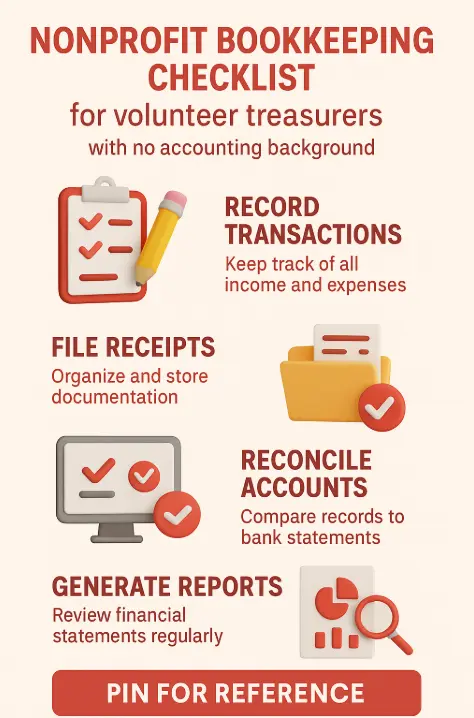
Volunteer treasurers don’t need to master advanced accounting principles. What matters most is creating consistent routines—recording transactions, reconciling accounts, monitoring cash flow, and keeping documentation up to date. These habits protect the organization’s financial integrity and ensure that leadership can make informed decisions, especially when paired with Outsourced Accounting support that can fill gaps and strengthen long-term consistency.
This checklist gives you a streamlined structure for those responsibilities, breaking tasks into monthly, quarterly, and annual actions so nothing falls through the cracks. By following it, you’ll gain confidence, support your board, and keep your nonprofit’s mission moving forward with clarity and financial accuracy.
“After working with volunteer treasurers for more than a decade, we’ve learned that strong nonprofit bookkeeping isn’t about mastering technical accounting—it’s about building simple, repeatable habits that keep your mission protected. When treasurers have a clear checklist and a trusted workflow, even those with zero experience can maintain accuracy, transparency, and board-ready financials.” Accountix Solutions
Essential Resources on Nonprofit Accounting
Navigating nonprofit finances can feel overwhelming, especially for volunteer treasurers without an accounting background. At Accountix Solutions, we’ve guided hundreds of first-time treasurers, and we know the right tools and references make all the difference. These resources are handpicked to give you practical guidance, real-world insights, and step-by-step clarity—so you can confidently manage your nonprofit’s books, whether you’re supporting a community nonprofit or a Private School operating with the same mission-driven financial standards.
1. Association of Nonprofit Accountants & Finance Professionals (ANAFP) Your Go-To Network for Nonprofit Accounting Support
ANAFP connects you to expert accountants and finance professionals who specialize in nonprofits. Use it to find guidance, templates, and professional advice when you need help or want to ensure your practices are audit-ready.
Source: anafp.org
2. NetSuite – Beginner’s Guide to Nonprofit Accounting
This guide simplifies nonprofit accounting into actionable steps. Learn how to track funds, set up a chart of accounts, and understand the differences between fund accounting and traditional accounting—essential for first-time treasurers.
Source: netsuite.com
3. NetSuite – 17 Best Practices for Nonprofit Bookkeeping
Designed for real-world application, this resource outlines critical internal controls, budgeting strategies, and compliance steps. It’s a practical checklist for building transparent and reliable bookkeeping processes.
Source: netsuite.com
4. Virginia Society of Certified Public Accountants (VSCPA) Nonprofit Resource Guide
This comprehensive guide covers accounting principles, tax requirements, banking, compliance, and governance. Perfect for volunteer treasurers who want to ensure their nonprofit meets all regulatory obligations.
Source: vscpa.com
5. Nonprofit Bookkeeping Guide, LLC – Hands-On DIY Guidance
Written by experienced nonprofit bookkeepers, this guide walks you through practical, day-to-day bookkeeping. It’s approachable, actionable, and perfect for volunteers managing finances without formal accounting training.
Source: nonprofitbookkeepingguide.com
6. Sage – Best Practices in Nonprofit Accounting
Sage helps you choose the right systems and processes to track donations, grants, and financial compliance. It’s ideal for nonprofits ready to adopt software or refine their workflows for accuracy and efficiency.
Source: sage.com
7. Nonprofit Financial Commons (NFC) – Library of Tools & Best Practices
NFC offers a rich library of articles, templates, and checklists for ongoing learning. Use it to stay up-to-date, improve your bookkeeping routines, and manage your nonprofit’s finances with confidence.
Source: cpajournal.com
Supporting Statistics (Scannable Version)
Below is the condensed, scannable version of the Supporting Statistics section, rewritten in the Accountix Solutions voice while keeping the original insights.
Key Insights Backed by Trusted U.S. Sources
The nonprofit landscape is massive.
Over 1 million registered nonprofits in the U.S.
Many volunteer treasurers underestimate this complexity.
Source: https://www.irs.gov/charities-non-profits/exempt-organizations-business-master-file
Most small nonprofits rely on internal bookkeeping—not IRS filings—for accuracy.
Only 323,417 nonprofits filed a full IRS Form 990 in 2021.
Abbreviated filings mean your internal books carry the real accountability.
Source: https://www.irs.gov/statistics/soi-tax-stats-irs-data-book Nonprofits manage trillions—and consistency matters at every size.
1.9 million active nonprofits represent $4.1 trillion in revenue.
We see firsthand how accurate books protect donor trust, even in small organizations.
Source: https://projects.propublica.org/nonprofits/
Final Thoughts & Opinion
Strong nonprofit accounting isn’t just compliance—it’s the foundation of sustainable impact. Clear systems and smart financial practices give organizations the agility they need to grow with confidence, much like Marketing Agencies that rely on streamlined processes to stay adaptable and results-driven.
What Experience Shows
From working with founders and nonprofit teams, the organizations that thrive are the ones that:
Treat finance as a strategic function, not an administrative task.
Build a chart of accounts that reflects real operations.
Use tools that simplify—not complicate—daily work.
Lean on expert support when internal capacity isn’t enough.
Why It Matters
A well-managed financial system leads to:
Better decision-making
Stronger donor and board trust
Easier grant writing and reporting
Less time spent fixing preventable issues
The Bottom Line
When nonprofits adopt even a few of these practices, the benefits show up fast—in cleaner numbers, smoother operations, and greater confidence in the path ahead.
Next Steps
Review Your Current System
Check your chart of accounts, reports, and workflows.
Note what works and what doesn’t.
Identify Priority Fixes
Choose 2–3 high-impact improvements.
Set a simple timeline.
Choose the Right Tools
Pick software that supports fund accounting and donor reporting.
Make sure it fits your size and needs.
Document Processes
Create short SOPs for coding, reconciling, and reporting.
Keep them clear and easy to follow.
Align Your Team
Share updates with staff or volunteers involved in finances.
Offer quick training.
Add Expert Support (Optional)
Bring in a nonprofit accounting partner for setup or ongoing support.
Reduce guesswork and ensure compliance.
Reassess Regularly
Review systems quarterly.
Adjust as your organization grows.
FAQ on Nonprofit Accounting
Q: What sets nonprofit accounting apart?
Focuses on accountability, not profit.
Tracks dollars by purpose, donor intent, and program impact.
Based on patterns we see across small nonprofits.
Q: Why is fund accounting essential?
Separates restricted, unrestricted, and grant funds.
Prevents common compliance issues we fix often.
Keeps donor reporting accurate.
Q: Do small nonprofits need a chart of accounts?
Yes—clarifies programs, admin, fundraising, and restricted funds.
Even small volunteer-led groups benefit immediately.
Q: Which financial statements matter most?
Statement of Activities = operational performance.
Statement of Financial Position = overall health.
These two guide most day-to-day decisions.
Q: When should nonprofits outsource accounting?
When treasurers spend too much time troubleshooting.
When accuracy, continuity, or audit readiness becomes urgent.
Helps stabilize reporting during grant cycles.