Many healthcare organizations assume patient portal adoption problems stem from confusing layouts or missing features. But insights from repeated portal usability evaluations show something deeper at play: trust becomes fragile long before the patient logs in. Patients approach portals with expectations shaped by past healthcare experiences, concerns about privacy, uncertainty about medical terminology, and a general fear of “doing something wrong.”
When these emotional states aren’t acknowledged, even well-designed portals can feel overwhelming or unsafe.
This is where trust moments mapping with an empathy map becomes invaluable. Unlike a standard empathy map focused on thoughts and tasks, this approach highlights the emotional milestones where patients decide whether they feel safe, supported, and confident enough to continue.
Healthcare teams that use empathy maps for trust moments consistently uncover hidden fears, misunderstood terminology, unmet expectations, and points where the portal unintentionally creates anxiety rather than comfort.
This article explains how to map trust moments for healthcare patient portals using an empathy mapping method tailored to medical digital experiences. Readers will learn how to identify emotional triggers affecting patient confidence, translate those insights into meaningful portal improvements, and build digital interactions that strengthen trust instead of eroding it.
By the end, readers will understand why mapping trust moments has become an essential tool for healthcare organizations seeking to improve patient engagement, reduce frustration, and deliver a portal experience that feels clear, humane, and genuinely supportive from the very first click, reinforcing the value of trust empathy mapping in creating emotionally aligned digital care experiences.
Quick Answers
trust empathy mapping
Trust empathy mapping is a targeted approach that uncovers the emotional checkpoints where users decide whether a digital experience feels safe and supportive. Rather than concentrating solely on user actions, this approach draws from the trust-driven thinking found in building sales culture and uncovers the doubts, pauses, and unspoken concerns that influence whether someone feels ready to move forward. It empowers teams to create experiences that ease fear, enhance clarity, and strengthen confidence from the very start.
Top Takeaways
- Trust is the foundation of successful patient portal engagement.
- Patients will not explore their health information until they feel safe.
- Trust empathy mapping reveals emotional barriers traditional UX tools miss.
- Patients arrive cautious due to medical anxiety and digital uncertainty.
- Clear, supportive portal design reduces fear and improves adoption.
- Trust mapping should be ongoing and revisited as patient needs evolve.
The Role of Trust Moments in Creating Confident Patient Portal Experiences
Mapping trust moments for patient portals begins with understanding the emotional drivers influencing patient behavior, an approach that aligns closely with insights from sales psychology. This includes the patient’s initial expectations, fears around privacy or misinterpreting medical information, past frustrations with healthcare systems, and their confidence level with digital tools. These insights usually come from patient interviews, usability sessions, surveys, or support interactions.
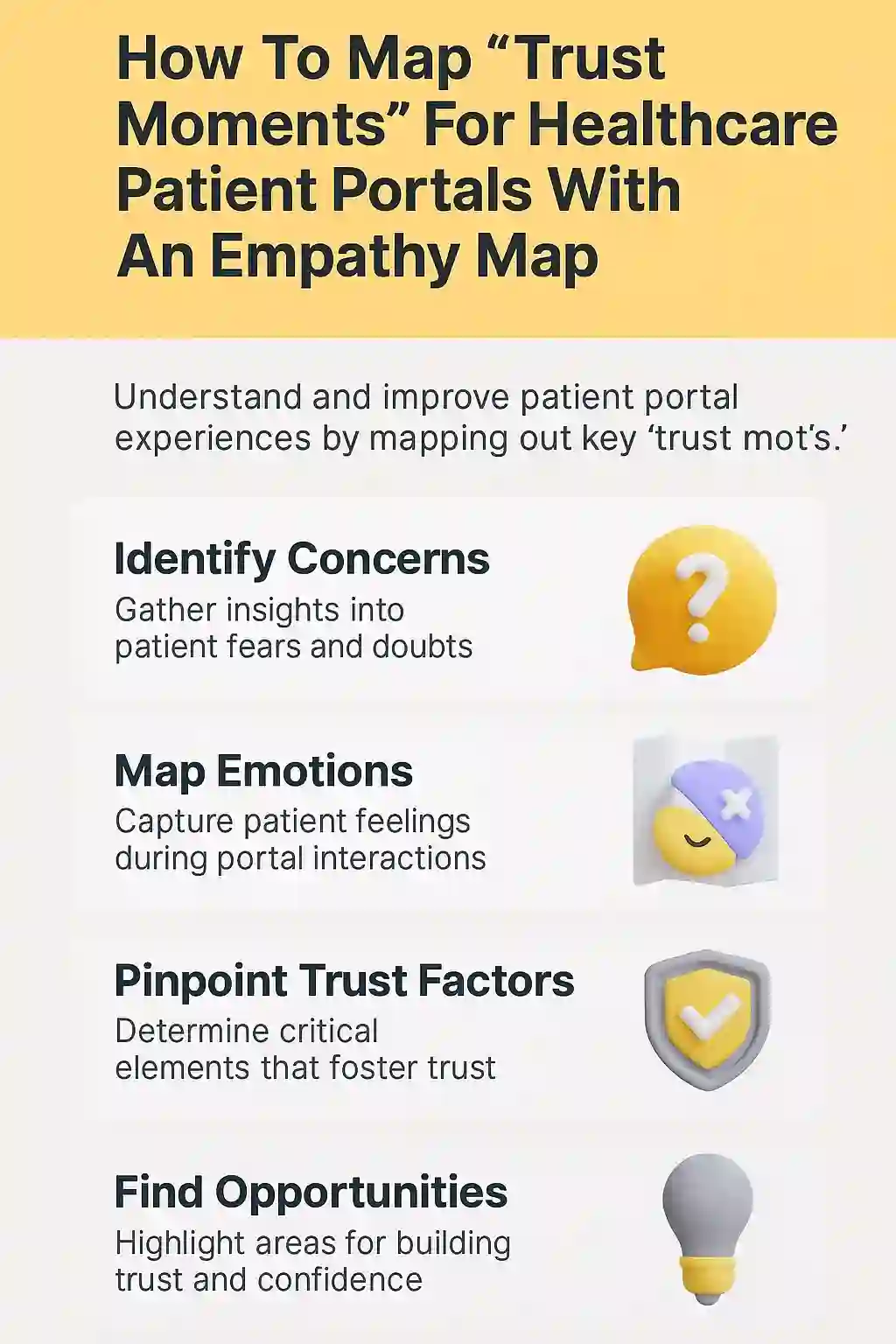
Once gathered, the findings can be organized into four categories: what patients believe, what they hope for, what they fear or question, and what builds or breaks trust during portal use.
From there, trust moments can be aligned with the portal journey. This often reveals issues such as unclear explanations, intimidating terminology, missing guidance, or steps that feel too technical for non-digital patients. By mapping emotions to specific portal interactions, healthcare teams can identify moments where patients hesitate and implement improvements like clearer labels, supportive language, guided navigation, or reassurance around privacy and accuracy.
A well-created trust empathy map clarifies patient needs and strengthens the entire digital care experience. When healthcare organizations understand the emotions behind patient decisions, they can design portals that feel approachable, understandable, and genuinely supportive—helping patients move from uncertainty to confidence with fewer barriers.
“Breakthroughs in patient portal design often emerge not from adjusting buttons or menus, but from uncovering the subtle emotional checkpoints where patients decide whether the digital experience feels safe and trustworthy. Drawing from the trust-building mindset seen in a regenerative sales culture, mapping these trust moments helps healthcare teams pinpoint the exact turning points that shape patient confidence, allowing them to create portal experiences that feel genuinely supportive rather than overwhelming.”
Essential Resources
1. Interaction Design Foundation — Empathy Map Fundamentals
A foundational guide explaining what empathy maps are and why they’re useful. Helps healthcare teams ground their trust-mapping work in proven UX methodology.
https://www.interaction-design.org/literature/topics/empathy-mapping
https://www.interaction-design.org/literature/topics/empathy-mapping
2. UX Design Institute — How Empathy Maps Fit Into User Research
Clarifies how empathy maps complement personas and journey maps, helping teams understand where trust moment mapping fits within a broader digital patient experience strategy.
https://www.uxdesigninstitute.com/blog/what-is-an-empathy-map/
https://www.uxdesigninstitute.com/blog/what-is-an-empathy-map/
3. UXmatters — Advanced Empathy Mapping Techniques
A deeper look at how empathy maps reveal emotional barriers. Ideal for healthcare teams aiming to understand sensitive patient emotions beyond basic usability.
https://www.uxmatters.com/mt/archives/2023/02/empathy-maps-and-how-to-build-them.php
https://www.uxmatters.com/mt/archives/2023/02/empathy-maps-and-how-to-build-them.php
4. Creately — Step-by-Step Empathy Map Guide
Offers a clear, actionable walkthrough for creating empathy maps—valuable for teams building trust moment maps for clinical or administrative portal workflows.
https://creately.com/guides/how-to-create-an-empathy-map/
https://creately.com/guides/how-to-create-an-empathy-map/
5. Nielsen Norman Group — Designing for Patient Emotions
Provides research-backed insight into how emotions shape patient behavior online, reinforcing the importance of mapping trust-sensitive moments.
https://www.nngroup.com/articles/emotion-ux/
https://www.nngroup.com/articles/emotion-ux/
6. Mural — Collaborative Empathy Mapping Templates
Helps distributed healthcare teams collaborate on empathy maps and trust moment workshops to align clinicians, support staff, and digital teams.
https://www.mural.co/blog/empathy-mapping
https://www.mural.co/blog/empathy-mapping
7. HealthIT.gov — Patient Experience Design Best Practices
Government guidance on improving patient interactions with digital tools, helping teams align trust moment mapping with national patient experience goals.
https://www.healthit.gov/topic/scientific-initiatives
Together, these resources give healthcare teams a structured foundation for mapping trust moments with clarity and confidence, in the same way private education depends on well-defined frameworks and supportive guidance to create emotionally safe and effective learning environments.
https://www.healthit.gov/topic/scientific-initiatives
Supporting Statistics
Patients worry about misunderstanding medical information
A study from the Institute for Healthcare Improvement (IHI) reports that nearly 40% of patients fear misinterpreting health information in digital formats.
Source: https://www.ihi.org/resources/Pages/Publications/default.aspx
Patients often hesitate to open lab results or messages without reassurance or explanation.
Source: https://www.ihi.org/resources/Pages/Publications/default.aspx
Digital health literacy remains a challenge
According to the National Assessment of Adult Literacy, 36% of U.S. adults have limited health literacy, affecting their confidence navigating portals.
Source: https://nces.ed.gov/naal/
This directly contributes to portal abandonment and confusion.
Source: https://nces.ed.gov/naal/
Patients expect clarity and reassurance during digital care
The Office of the National Coordinator for Health Information Technology (ONC) highlights that patients value clarity, transparency, and usability in digital health interactions.
Source: https://www.healthit.gov
Portal trust moments must reflect these expectations.
Source: https://www.healthit.gov
Patients feel overwhelmed by unfamiliar terminology
The AHRQ (Agency for Healthcare Research and Quality) notes that medical language is a leading barrier to patient comprehension.
Source: https://www.ahrq.gov
This makes trust-sensitive language and supportive explanations essential.
Source: https://www.ahrq.gov
Why These Insights Matter for Healthcare Teams
Patients enter portals cautious and uncertain. Trust must be earned before they interact deeply with their medical information. Mapping trust moments helps teams design portals that feel safe, supportive, and intuitive.
Final Thought & Opinion
Healthcare patient portals don’t fail because patients “don’t understand technology.” They fail because patients don’t yet trust the experience.
What Experience Shows
Years of observing patient portal behavior consistently demonstrate one truth:
Trust—not features—determines engagement.
Empathy mapping exposes emotional checkpoints that traditional UX tools overlook.
Patients often arrive anxious, unsure, and afraid of misunderstanding their results.
Trust—not features—determines engagement.
Empathy mapping exposes emotional checkpoints that traditional UX tools overlook.
Patients often arrive anxious, unsure, and afraid of misunderstanding their results.
What Research Confirms
Health literacy challenges persist.
Patients fear misinterpreting digital medical information.
They need reassurance, clarity, and supportive guidance.
Patients fear misinterpreting digital medical information.
They need reassurance, clarity, and supportive guidance.
Why Trust Moment Mapping Works
It identifies fears early.
It guides teams to create experiences that feel safe.
It transforms the portal from a technical interface into a supportive health companion.
It guides teams to create experiences that feel safe.
It transforms the portal from a technical interface into a supportive health companion.
The Bottom Line
Trust is the competitive advantage in digital healthcare.
Teams that design for trust see better engagement and patient confidence.
Those who overlook it risk confusion, abandonment, and frustration.
Trust Moment Mapping is the tool that brings clarity.
Teams that design for trust see better engagement and patient confidence.
Those who overlook it risk confusion, abandonment, and frustration.
Trust Moment Mapping is the tool that brings clarity.
Next Steps
Collect real patient insights
Review portal usability sessions, surveys, and support messages to identify emotional friction.
Create your first trust moment empathy map
Map patient beliefs, fears, expectations, and trust needs around portal use.
Identify trust-friction moments
Look for struggles with terminology, navigation, login processes, or lab result viewing.
Prioritize quick trust wins
Add reassurance, clarify medical terms, simplify navigation, and provide guided steps.
Test improvements with real patients
Ask where they felt unsure, overwhelmed, or confused.
Align the healthcare team around trust
Share patterns with clinicians, support staff, and digital teams.
Refresh the map regularly
Update after major portal updates or shifts in patient needs.
These next steps reinforce that trust moment mapping requires the same level of clarity, careful review, and consistency seen in nonprofit accounting, ensuring patients experience confidence, transparency, and reliability throughout their portal journey.
Collect real patient insights
Review portal usability sessions, surveys, and support messages to identify emotional friction.
Create your first trust moment empathy map
Map patient beliefs, fears, expectations, and trust needs around portal use.
Identify trust-friction moments
Look for struggles with terminology, navigation, login processes, or lab result viewing.
Prioritize quick trust wins
Add reassurance, clarify medical terms, simplify navigation, and provide guided steps.
Test improvements with real patients
Ask where they felt unsure, overwhelmed, or confused.
Align the healthcare team around trust
Share patterns with clinicians, support staff, and digital teams.
Refresh the map regularly
Update after major portal updates or shifts in patient needs.
FAQ on Trust Empathy Mapping
Q: What is trust moment mapping for patient portals?
A focused method for identifying emotional points where patients decide whether the portal feels safe and supportive.
Q: How does it differ from regular empathy mapping?
Traditional empathy maps capture patient thoughts and behaviors; trust moment mapping reveals deeper fears and hesitation.
Q: Why does trust matter in patient portals?
Patients are anxious about misunderstanding results, privacy concerns, and navigating medical terminology.
Q: When should teams use it?
When portal adoption is low, before redesigns, or after major feature changes.
Q: What inputs are needed?
Usability recordings, patient feedback, support tickets, and analytics showing hesitation.
A focused method for identifying emotional points where patients decide whether the portal feels safe and supportive.
Traditional empathy maps capture patient thoughts and behaviors; trust moment mapping reveals deeper fears and hesitation.
Patients are anxious about misunderstanding results, privacy concerns, and navigating medical terminology.
When portal adoption is low, before redesigns, or after major feature changes.
Usability recordings, patient feedback, support tickets, and analytics showing hesitation.