Your CPA has the tax projections. Your estate attorney has the trust documents, and your investment advisor has last quarter's statements, but nobody in that group is looking at all of it together.
Outsourced family office executive services close that gap. An outside firm provides the senior leadership a family office would normally hire for, usually a personal CFO and a coordinator for your advisors, with investment oversight when you need it. One coordinated team keeps your decisions moving and your follow-through consistent.
Most families reach this point gradually. The wealth came from a business, farmland, real estate, or a sale, and over the years it picked up an insurance agent, a couple of trusts, and a few LLCs to go with the advisors. Each professional does good work. The job of connecting them quietly falls to you.
You forward emails between advisors. You chase signatures and try to remember which account pays the property taxes. Add private school tuition for two or three kids in Los Angeles, and the financial calendar fills up fast.
A traditional family office solves this by hiring staff. Most families don't want to build a company just to run their finances, and they shouldn't have to.
TL;DR Quick Answers
Outsourced Family Office Executive Services
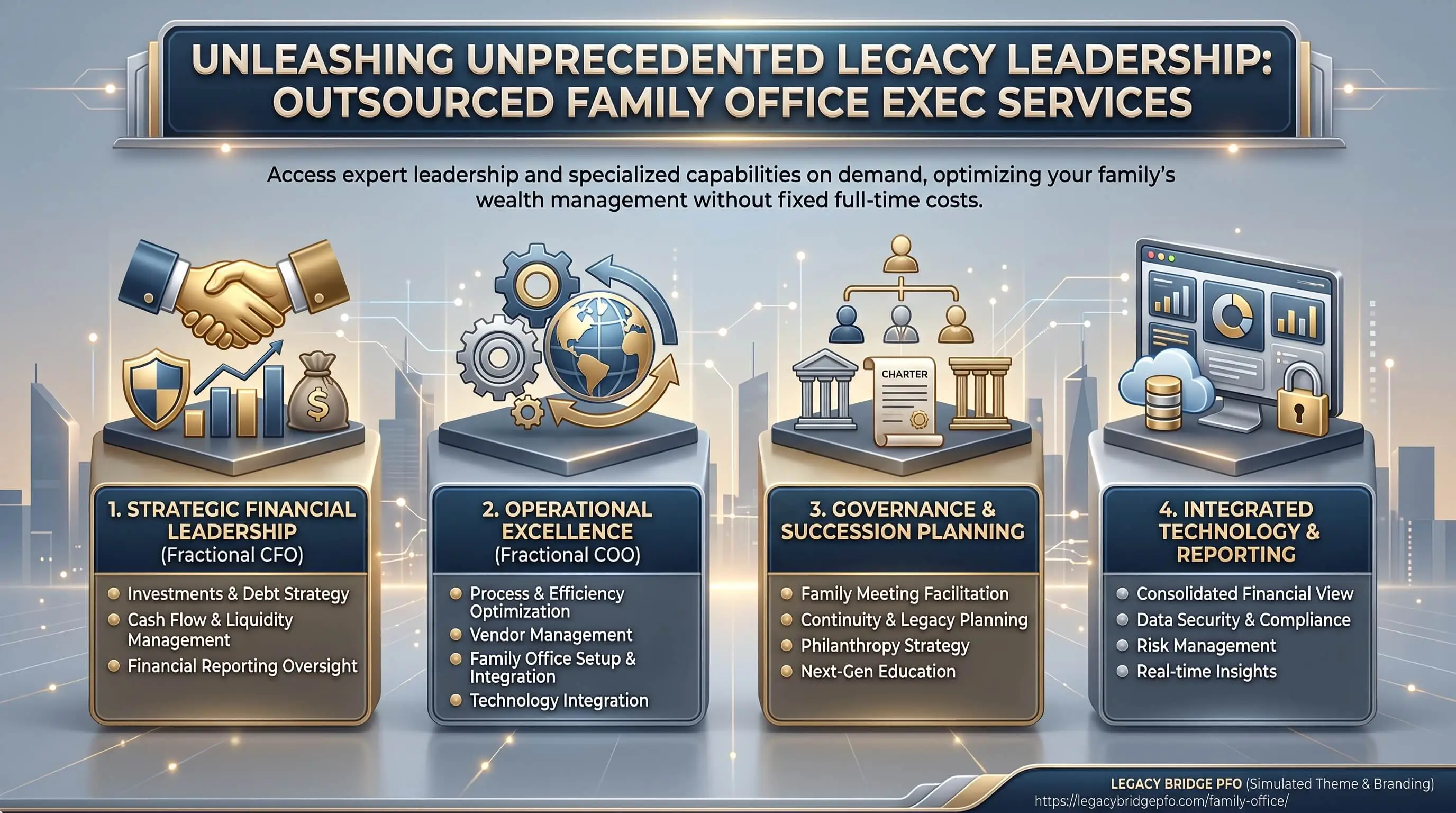
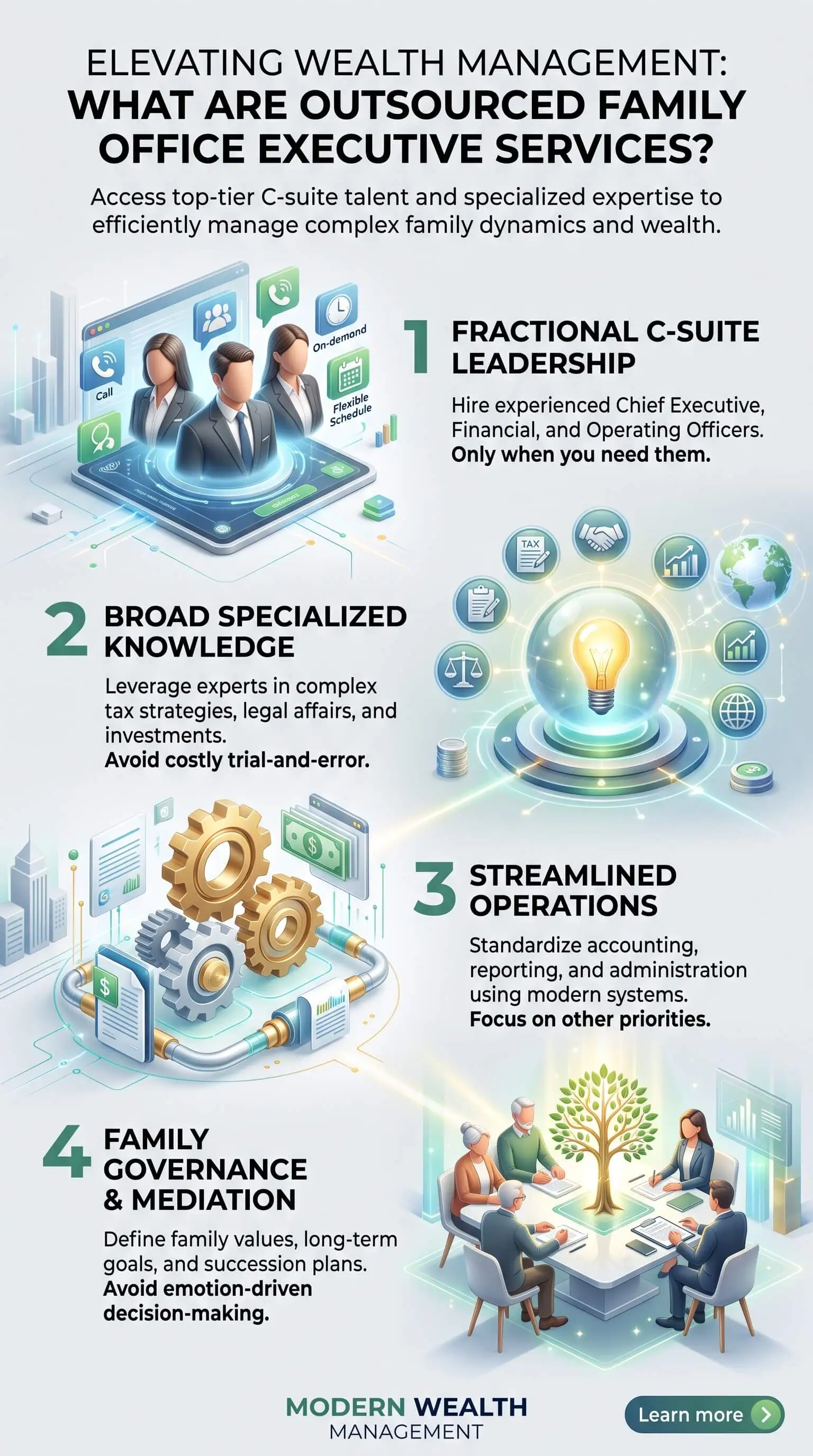
Outsourced family office executive services give a family senior financial leadership from an outside firm instead of in-house hires. The core role is a single point of accountability who keeps your CPA, attorney, and investment advisors working from shared context and turns decisions into follow-through.
What you get: A personal CFO for cash flow and balance sheet oversight, a coordinator for your advisors, and investment oversight through a registered investment adviser.
What it fixes: Good advice that never gets connected, which causes more trouble than bad advice.
What it doesn't do: Replace your CPA or attorney. They keep giving tax and legal advice while the executive coordinates alongside them.
Who it fits: Families with a business interest, multiple entities or trusts, or an upcoming sale or generational transition.
How to vet a provider: Confirm fiduciary status, read the Form CRS, and get the fees and scope in writing.
Top Takeaways
Outsourced family office executive services put senior financial leadership in place without a full in-house staff.
The biggest payoff is one accountable partner who keeps your existing advisors working from the same facts.
In-house teams make sense at a very large scale, while outsourced models fit most families with complex wealth.
A pending sale, a growing number of entities, or a generational handoff usually signals it's time.
Check fiduciary status, the Form CRS, fees, scope, and security practices before you hire anyone.
What Outsourced Family Office Executive Services Include
Think of it as leadership first and bookkeeping second. Bill pay and tax prep still matter, yet the gap we see most often is simpler, since no single person is responsible for connecting the pieces.
Personal CFO and Financial Oversight
A personal CFO watches your whole balance sheet. That covers cash flow across households and entities, budgets, and whether there's enough liquidity for what's coming next spring. Before a big decision, they ask the questions your other advisors might not think to raise. Afterward, they make sure the action items actually get done.
Family Office Director and Advisor Coordination
This is your single point of accountability. One partner tracks priorities, keeps your CPA, attorney, and insurance professional working from a shared context, and records what the family decided and why. Legacy Bridge built its family office services that coordinate your advisors around this model, because in our experience the handoffs between advisors cause far more trouble than the advice itself.
Investment Oversight Without an In-House CIO
Large single-family offices hire a chief investment officer. Families using an outsourced model get that oversight through a registered investment adviser, who sets investment policy, monitors managers, and delivers consolidated reporting you can actually read.
Governance, Estate, and Wealth Transfer Leadership
Money is only part of the job. A family office also runs family meetings and sets up how decisions get made. It keeps the estate plan and giving strategy in step with a family that keeps changing.
In-House Executives vs. Outsourced Executive Services
Both models work. Which one fits depends on how complex your wealth is and how much of an organization you want to run.
Cost structure: In-house means a salary, benefits, office space, and technology for every hire. Outsourced teams share a platform and usually charge a flat fee, a retainer, or an asset-based fee.
Control: An in-house staff reports directly to you, which gives you the most hands-on control. With an outsourced team, you set the scope and keep the decision rights.
Depth of expertise: An in-house team knows what its hires know. An outsourced firm brings tax, estate, investment, and administrative specialists to the table.
Continuity: When a key in-house employee leaves, a lot of knowledge can walk out the door with them. Outsourced teams rely on shared coverage and documented workflows.
Privacy and security: In-house, you build every safeguard yourself. Established providers already have secure systems and permissioned access in place.
Scalability: New needs in-house usually mean new hires. An outsourced scope grows or shrinks with you.
For very large, very complex fortunes, a full in-house staff can make sense. For most of the families we talk with, it's more organization than they need.
How Outsourced Executives Strengthen Leadership, Oversight, and Decision-Making
On the leadership side, someone finally owns the priorities list. Deadlines and follow-ups stop depending on whoever in the family has a free evening.
Oversight gets steadier. Reports arrive on a schedule, documents live in one secure place, and you can see every account and entity without rebuilding the picture each April.
Decision-making is usually where families feel the difference first. When the CPA, attorney, and investment advisor work from the same facts, their recommendations stop pulling in different directions. Your executive writes down the reasoning behind each choice, so nobody has to reconstruct it two years later.
Picture a family getting ready to sell its operating business. The CPA is modeling the tax hit while the attorney updates the trusts. Meanwhile, the wealth advisor is planning for the proceeds, and each of them is working from a slightly different version of the facts. An outsourced executive maps every entity, deadline, and open item, then puts the whole team on one timeline. The sale still takes work. There are just fewer surprises at closing, and the family gets to think about what comes after.
A good outsourced executive coordinates alongside your trusted professionals, including outsourced business and financial accounting firms, and leaves their roles intact.
Signs Your Family Is Ready for Outsourced Executive Support
It's rarely one event. More often, a few of these show up around the same time:
A business sale, liquidity event, or large inheritance is coming up or just happened
You manage multiple entities, trusts, or properties
A key family member or long-time employee is stepping back
The next generation is starting to take on responsibility
Your advisors rarely talk to each other
Reports arrive late, in pieces, or in formats nobody reads
Financial admin keeps eating into your evenings and weekends
If several of those sound familiar, a coordinated executive team is worth a closer look.
Where Education Planning Fits for Los Angeles Families
For a lot of Los Angeles families, education is one of the biggest checks they write every year. Tuition for several kids, grandparents who want to help, 529 plans, and education trusts all have to fit with cash flow and the estate plan.
An outsourced executive treats tuition as part of the full picture rather than a separate bill. They schedule payments around liquidity and time grandparent gifts with the estate plan in mind. They also review college savings every year instead of leaving those accounts untouched. If you're still working through the numbers, this guide to affording private schools in California lays out practical options.
There's a second kind of education, too. Good family offices help the next generation understand how the family's wealth is structured and how decisions get made, long before anyone hands them the keys.
How to Evaluate an Outsourced Family Office Provider
Before you sign anything, get clear answers to these:
Is the firm a fiduciary? Look it up on the SEC's Investment Adviser Public Disclosure site and review its registration and any disciplinary history.
How does it get paid? Read the Form CRS and ask whether fees are flat, retainer-based, or tied to assets.
What exactly is in scope? Ask for a written list of services and who handles each one.
Will it work with your current advisors? A good provider coordinates the team you have instead of pushing you to replace it.
How does it protect your information? Ask about secure systems, access controls, and who sees what.
What will reporting look like? Request a sample report and the reporting schedule.
What happens if your lead contact leaves? Team-based coverage and documented workflows are what protect continuity.
"Every family office of any size depends on layers of accountability and governance."
7 Essential Resources
SEC Family Office Small Entity Compliance Guide. How the SEC defines a family office under the Investment Advisers Act, and why most single-family offices don't have to register as advisers.
Investor.gov: Form CRS Relationship Summary. The SEC's guide to reading a firm's relationship summary, which spells out services, fees, conflicts of interest, and disciplinary history.
Investor.gov: Check Out Your Investment Professional. A walkthrough of the SEC's adviser database, so you can confirm a firm's registration and record before you hire it.
Deloitte Private: Defining the Family Office Landscape. Global research on how many single-family offices exist, how much wealth they oversee, and where the numbers are heading by 2030.
UBS Global Family Office Report. An annual survey of family offices worldwide, with sections on asset allocation, governance, and succession planning.
RSM: Outsourcing Family Office Operations. Which functions families tend to outsource, what usually triggers the decision, and how confidentiality factors in.
IRS Topic No. 313: Qualified Tuition Programs. The IRS overview of 529 plans. It's a good starting point if you're lining up education funding with the rest of your plan.
Supporting Statistics
10,720 single-family offices by 2030. Deloitte Private estimates there are about 8,030 single-family offices worldwide today, up from 6,130 in 2019, and projects the count will reach 10,720 by 2030.
91% expect outsourcing to grow. When Ocorian surveyed more than 130 family office professionals, 91% said outsourcing will increase over the next three years. Six in ten already use outside firms to help manage family members' personal finances.
Only 35% have a defined succession plan. That figure comes from the UBS Global Family Office Report 2026.
Put those side by side and a pattern shows up. Family offices keep multiplying, more of them lean on outside help, and roughly two out of three still haven't written down how wealth will pass to the next generation. That last gap is where executive-level coordination tends to matter most.
Final Thoughts
While most families assume the fix is another advisor, what they usually need is someone who owns the coordination.
The CPA, the attorney, and the investment advisor are usually doing solid work. What's missing is the executive layer, the person who sees the full balance sheet and turns each decision into follow-through. Building that layer in-house costs more than most families want to spend. It's also fragile, because it tends to live in one employee's head.
Outsourced executive services aren't for everyone. If your finances are simple, you can probably skip them, and they only work when the scope is written down and the family keeps the final say. But if a sale is coming or the next generation is starting to ask questions, a coordinated team can give you clearer decisions and more of your time back.
Frequently Asked Questions
What does an outsourced family office executive do?
They oversee your family's financial life without being on your payroll. Day to day, that means watching cash flow and the balance sheet, coordinating your CPA, attorney, and investment advisors, tracking action items, and keeping documents organized. When a big decision comes up, they make sure everyone involved has the same information.
How are outsourced family office executive services different from a multi-family office?
The two overlap quite a bit. A multi-family office serves several families through a shared team and platform, and it's one of the most common ways families get outsourced executive support. The main difference from a single-family office is that you share infrastructure and specialists rather than employing your own.
How much do outsourced family office services cost?
It depends on scope and complexity. Most providers charge a flat fee, an annual retainer, an asset-based fee, or some mix. Ask for the firm's Form CRS and a written fee schedule, then compare the total against what it would cost to hire and keep qualified staff yourself.
Do outsourced executives replace our CPA or estate attorney?
No. Your licensed CPA and attorney keep giving tax and legal advice. The executive's job is to make sure they have what they need, stay in sync with each other, and follow through on what the family decides.
What level of wealth makes outsourced executive services worthwhile?
There's no fixed number. Complexity matters more than net worth. A family with a business interest, several trusts, real estate, or an upcoming liquidity event often benefits well before it would ever make sense to build a single-family office.
How do outsourced providers protect family privacy?
Reputable firms use secure document systems, permission-based access, and written policies on who can see what. Ask any provider you're considering to walk you through its controls in plain terms.
Can an outsourced family office help plan for children's and grandchildren's education?
Yes, and it's one of the more common requests. An outsourced executive can line up tuition payments with cash flow, coordinate grandparent gifts and 529 contributions with the estate plan, and help prepare the next generation to understand the family's wealth.
Bring Structure to Your Family's Wealth
Managing several advisors, a stack of entities, or a big transition shouldn't mean you're the one holding it all together. The Legacy Bridge team starts by mapping what you have, who's involved, and where things tend to slip. Remote outsourced QuickBooks bookkeeping services can then support the day-to-day financial coordination that keeps everything organized. From there, you'll see what one coordinated team could take off your plate. Schedule a private consultation to start that conversation.