Wealth rarely stays simple, and the weeks after a business sale prove it. Three firms show up with polished decks, and by the third meeting every pitch sounds the same, promising a coordinated team, personal attention, and an easy working relationship with your CPA.
So how do you choose? Confirm the firm acts as a fiduciary, match its family office services to what your family actually needs, get a plain answer on how it's paid, and test how it will work with the advisors you already trust. Do all four before you sign anything.
A traditional family office hires its own staff to run a family's financial life. An outsourced provider delivers much of that work through a shared team, which is why the firm itself matters as much as the services it lists. You're choosing the team and the follow-through that keep everything connected.
If the model is new to you, start with this overview of what outsourced family office executive services include. For Los Angeles families, the provider will likely handle everyday obligations like tuition alongside the big decisions, so the fit has to work on both fronts.
TL;DR Quick Answers
Family Office Services
Family office services bring a family's investments, taxes, estate plan, and financial administration under one coordinated team, with a single point of contact who keeps every advisor working from the same plan.
What they cover: Investment oversight, tax strategy, estate planning, wealth transfer, family governance, philanthropy, administration, and consolidated reporting.
What they solve: Good advice that never gets connected. When the CPA, attorney, and portfolio each run on their own, complexity builds and details slip.
How the model works: A multi-family office like Legacy Bridge shares one integrated team across several families, so one call reaches everyone and you don't have to build your own staff.
Who they fit: Business owners, executives, retirees, and multi-generational families, especially around a liquidity event or generational transition.
What stays the same: Your CPA and attorney keep advising you while the family office coordinates alongside them.
Top Takeaways
Check fiduciary status first by pulling the firm's Form ADV and Form CRS from the SEC's public database.
Match the provider's family office services to your family's real needs, and ask which ones its own team delivers.
Insist on one accountable lead, and get the client-to-staff ratio in writing.
Compare total cost, including outside manager fees, rather than headline quotes.
Walk away from vague fee answers, pressure to move assets quickly, or resistance to your current advisors.
What Do Family Office Services Actually Include?
Most providers list a similar set of family office services. Where they differ is in who does the work. Some firms keep most of it in-house, while others refer much of it out and coordinate from the middle.
A full scope usually includes:
Investment oversight and consolidated reporting
Tax strategy and tax-time readiness
Estate planning and wealth transfer
Family governance and next-generation education
Philanthropy and giving strategy
Administration, bill pay, and document management
Concierge and lifestyle logistics
Ask every firm which of these its own people handle and which get handed off. In our experience, the handoffs are where things slip, so a long menu means little unless someone owns what happens after the referral.
Ask about the everyday items, too. Tuition for two or three kids, a grandparent's gift toward school, and 529 contributions all belong in the same plan as the trusts and investment accounts. If you're still working through those numbers, this guide to affording private schools in California is a useful place to start.
Which Family Office Model Fits Your Family?
Decide what kind of firm you need before you compare firms. In a July 2026 guide, Morgan Lewis frames the choice around control, cost, and complexity. It also points out something families often miss, which is that the right model tends to change as wealth and generations grow.
Single-family office: Usually fits families with roughly $100 million to $250 million or more in investable assets. You hire your own staff, run your own systems, and set your own governance, which gives you the most control at the highest cost.
Multi-family office: Often a fit between roughly $25 million and $150 million, or for larger families whose needs are fairly simple. Several families share one team and platform, so you get professional infrastructure with less room to customize.
Outsourced or virtual family office: Tends to suit families with roughly $50 million to $200 million, or anyone in transition after a liquidity event. A lean coordinating lead brings in outside specialists as needed. Without one person owning the integration, it can splinter.
Hybrid: Works for families building governance capacity over time, with some functions in-house and others outsourced. It holds together only when one person owns coordination.
Those asset ranges come from the Morgan Lewis guide, and they're starting points rather than rules. Complexity usually tells you more than net worth does. A family with a $100 million operating business, three trusts, and property in two states can need more coordination than a family holding $500 million in a simple public portfolio.
What Should You Look for in an Outsourced Family Office Provider?
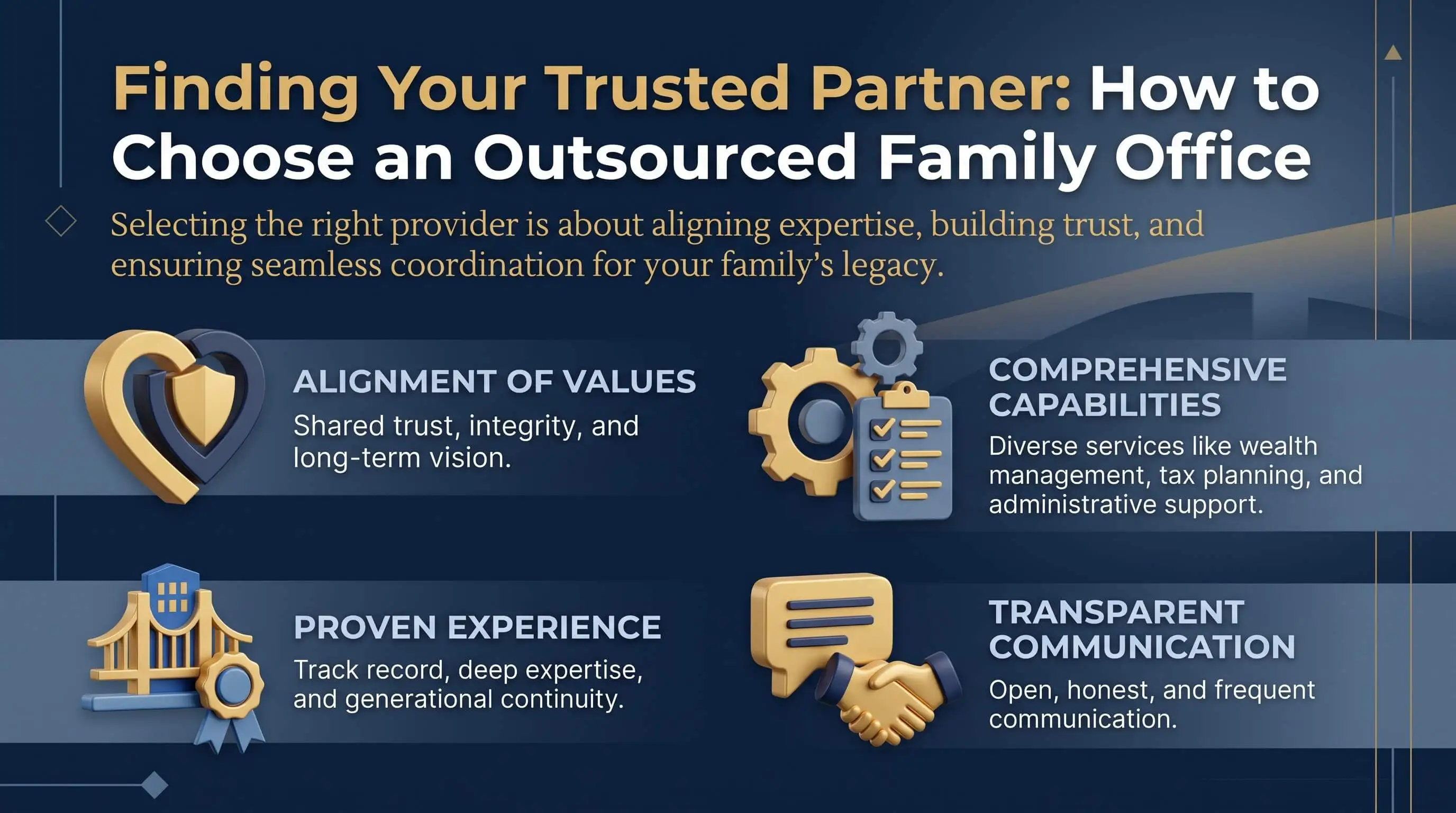
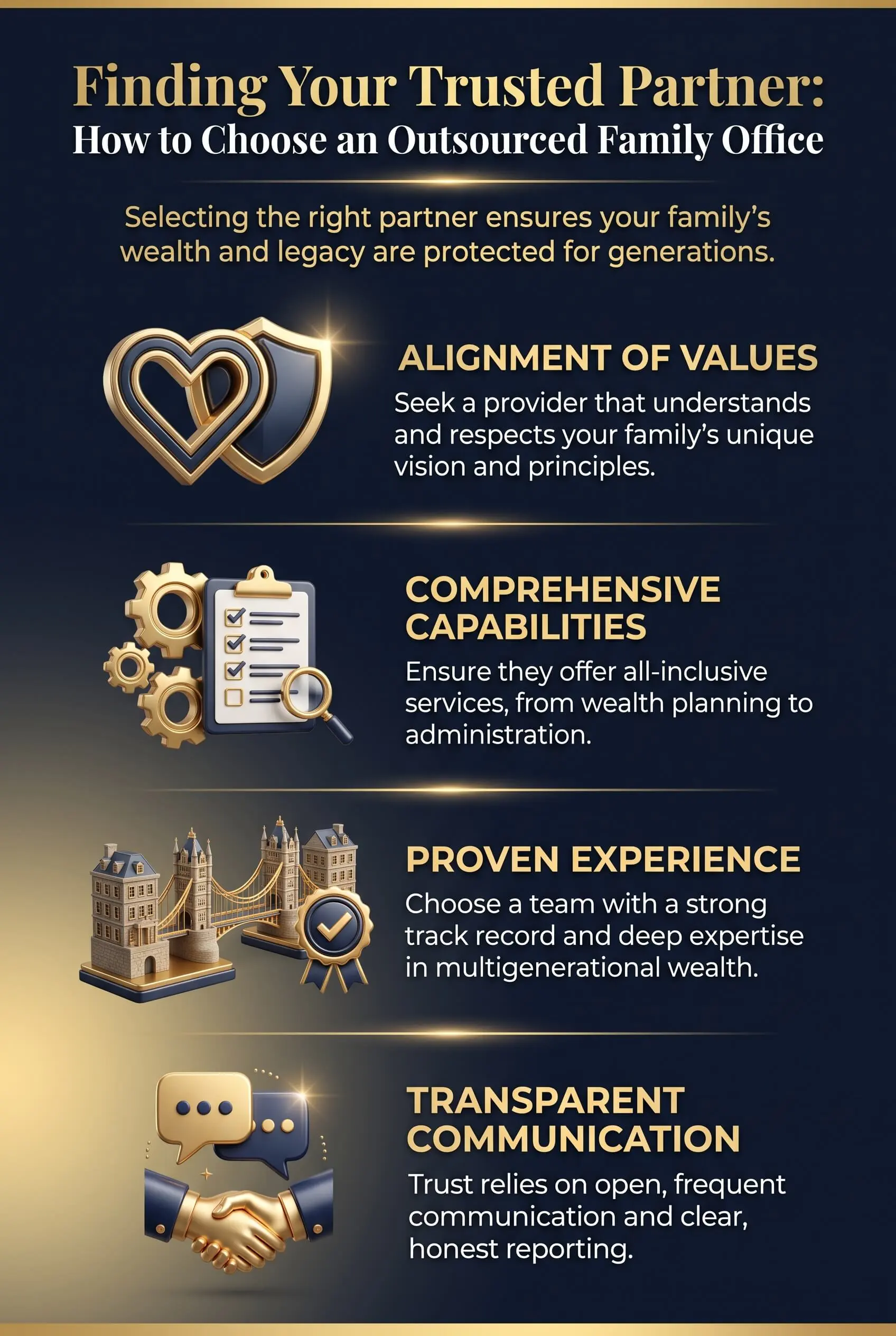
We'd point any family toward six things. Each one comes with a question worth asking in the first meeting.
Fiduciary Duty and Regulatory Standing
Start with the basics. A registered investment adviser owes you a fiduciary duty on the investment advice it gives. You can look up any firm on the SEC's adviser database, read its Form ADV brochure, and see whether it has a disciplinary record.
Ask: "Are you acting as a fiduciary for every service you provide us?"
One Accountable Lead
Families tend to underweight this one, and it's the one they feel most a year in. Find out who your day-to-day contact will be, how many families that person serves, and who picks up when they're away. At Legacy Bridge, a boutique private family office, a Personal CFO is the single point of contact, and one call reaches the whole team. The firm reported a 2:1 client-to-employee ratio as of November 2025. Whichever firm you choose, get that ratio in writing.
Ask: "Who will we call, and how many other families do they serve?"
Depth of the Team Behind Your Lead
One good person isn't enough. Your lead needs tax, estate, investment, and administrative specialists behind them, plus documented workflows so your family's history stays with the firm if someone moves on.
Ask: "If our lead left tomorrow, what would the handoff look like?"
Reporting You'll Actually Read
Every account, entity, and trust should land in one consolidated view on a schedule you can count on. If you're still rebuilding the full picture yourself each April, the reporting isn't working.
Ask: "Can we see a sample consolidated report, with client names removed?"
Privacy and Data Security
Sensitive documents belong in a secure system with permission-based access and a written policy on who sees what.
Ask: "Who on your team can see our documents, and how is that controlled?"
Fit With Your Advisors and Your Values
The right provider makes your CPA and attorney more effective instead of trying to replace them. Pay attention to how a firm talks about the professionals you already trust, and whether it asks about your family's priorities before pitching its own.
Ask: "How will you work with our CPA during tax season?"
How Do Outsourced Family Office Providers Charge?
Most firms use one of these fee models:
Asset-based fee, charged as a percentage of the assets the firm manages or advises on
Flat fee or annual retainer for a defined scope of work
Hybrid, usually an asset-based fee for investment management plus flat fees for tax, estate, or philanthropic planning
What the fee covers matters more than which model it follows. Ask what's included, what's billed separately, whether outside manager fees sit on top, and how the fee changes as your assets grow. Every registered adviser has to give you a Form CRS, a short relationship summary that lays out fees and conflicts in plain language. Read it before the second meeting.
We've watched families pick the lowest quote and then see the total climb once outside managers, tax prep, and legal work get added back. Price usually isn't what drives the choice anyway. In J.P. Morgan's 2026 Global Family Office Report, family offices said they chose outside providers mainly for expertise, access, and experience with families like theirs, and cost didn't make their list of top reasons.
How to Vet a Provider: A Step-by-Step Process
Write down what you need covered and what you want to keep with your current advisors.
Build a shortlist of three firms that serve families like yours.
Look up each firm on the SEC's adviser database, then read its Form ADV brochure and Form CRS.
Run a scenario interview. Try something like: "We're selling the business in 18 months. Walk us through your first 90 days."
Request a sample consolidated report and a sample engagement letter.
Ask for references from families with similar complexity.
Get scope, fees, and service expectations in writing before you sign.
Of the seven, the scenario interview usually tells you the most. A strong firm asks about your entities, your advisors, and your deadlines before it says much about itself.
Red Flags to Watch For
Vague or shifting answers about how the firm gets paid
Pressure to move all of your assets right away
No single person accountable for your family
Reluctance to work with your existing CPA or attorney
In-house investment products offered as the default
A sample report you can't follow, or no sample at all
"Most families who come to us already have good advice. What's missing is someone connecting it. The CPA is solid, the attorney is solid, the portfolio is fine, and still nobody is watching the whole picture. So before we recommend anything, we map every account, entity, advisor, and recurring obligation, and that map almost always shows where things have been slipping through. When you compare providers, skip the longest service menu. Look for the firm that can show you, in specifics, how it will help the advisors you already trust work as one team."
7 Essential Resources
SEC Investment Adviser Public Disclosure. Look up any advisory firm's registration, Form ADV brochure, and disciplinary history for free.
Investor.gov: Form CRS Relationship Summary. The SEC's plain-language guide to what a relationship summary tells you about services, fees, conflicts of interest, and past discipline, and where to find one.
FINRA BrokerCheck. Check the licenses, work history, and any reported violations for the individual brokers and advisors on a provider's team.
CFP Board: Verify a CFP Professional. Confirm whether a planner actually holds CFP certification and whether the CFP Board has publicly disciplined them.
Morgan Lewis: Control, Cost, and Complexity. The July 2026 guide behind the model ranges above, comparing single-family, multi-family, outsourced, and hybrid structures.
J.P. Morgan Private Bank: 2026 Global Family Office Report. Findings from 333 family offices in 30 countries on operating costs, outsourcing, governance, and succession.
Kaufman Rossin: Should You Outsource Your Family Office? A CPA firm's checklist of what to settle before outsourcing, from staffing and regulation to privacy and cybersecurity.
Supporting Statistics
$3 million a year to run a family office. J.P. Morgan Private Bank's 2026 Global Family Office Report puts the average annual operating cost at $3 million, climbing to $6.6 million for offices with more than $1 billion in assets.
Legal, trading, and cybersecurity lead the outsourcing list. The same report found family offices hand off legal services (52%), trading and market execution (45%), and cybersecurity (38%) more than any other functions, with outside services making up 25% to 28% of total costs.
Shared models fit roughly $25 million to $150 million. Morgan Lewis notes that a multi-family office can give families in that range professional management without the overhead of a standalone office.
Read together, these figures point somewhere practical. Running your own office costs millions a year, and even the families who can afford one send key work to outside specialists, including managing expenses related to private schools. For most families below nine figures, outsourcing is the sensible default, so the decision that deserves your time is which provider earns the coordination role.
Final Thoughts
Service menus are where most families start comparing providers, and they tell you surprisingly little. Nearly every outsourced family office lists the same capabilities.
What separates one firm from another is who owns the coordination. Look for one accountable person with a real team behind them and a fee you can explain in a sentence. The firm should also treat your CPA and attorney as partners. A provider that can't walk you through your next tax season or your next major decision hasn't earned the role, however long its list runs.
Outsourcing isn't right for every family. With simple finances, a good advisor and a good CPA may be plenty. With a business interest, several trusts, or a transition ahead, though, this choice shapes how smoothly the next ten years go and how much of your legacy carries forward intact. Take your time with it. Ask the hard questions, and get everything in writing before you sign.
Frequently Asked Questions
What are family office services?
Family office services pull a family's financial life into one coordinated plan. That usually covers investment oversight, tax strategy, estate and wealth transfer planning, family governance, philanthropy, administration, and consolidated reporting. An outsourced provider delivers this through a shared team, so you don't have to hire your own staff.
How much does an outsourced family office cost?
It depends on scope and complexity. Most providers charge an asset-based fee, a flat fee or annual retainer, or a mix of the two. Ask for the firm's Form CRS and a written fee schedule, and confirm whether the firm bills outside manager, tax, or legal fees on top.
What's the difference between a multi-family office and an outsourced family office?
The two overlap quite a bit. A multi-family office serves several families through one shared team and platform. An outsourced or virtual family office usually runs leaner, with a coordinating lead who brings in specialists as needed. Either way, you get family office capabilities without building your own staff.
How much wealth do you need to use an outsourced family office?
There's no fixed minimum, and complexity matters more than net worth. Morgan Lewis notes that multi-family offices often fit families with roughly $25 million to $150 million in investable assets. Families with a business, several trusts, or a sale on the horizon often benefit sooner.
How do I check whether a provider is a fiduciary?
Search the firm on the SEC's Investment Adviser Public Disclosure site. Registered investment advisers owe a fiduciary duty on investment advice, and the Form ADV brochure and Form CRS spell out how the firm works. Then ask the firm directly whether that duty covers every service it provides you.
Can I keep my current CPA and estate attorney?
Yes, and a good provider will want you to. Your CPA and attorney keep giving tax and legal advice while the family office coordinates alongside them, so everyone works from the same information and your family's decisions actually move forward.
Does my family office provider need to be in Los Angeles?
No. Coordination, reporting, and secure document sharing all work well remotely, and plenty of families work with firms in other states. If in-person meetings matter to you, ask how often the team travels to clients and how it handles urgent requests across time zones.
Bring Clarity to Your Family's Wealth
You've built good relationships with your CPA, your attorney, and your advisors, and the right family office helps all of them work from the same page. At Legacy Bridge, every new relationship starts with a map of your accounts, entities, advisors, and recurring obligations, including matters related to family office trust management. From there, we'll show you where one coordinated team could take work off your plate, with a single call reaching everyone. Schedule a private consultation to start the conversation.